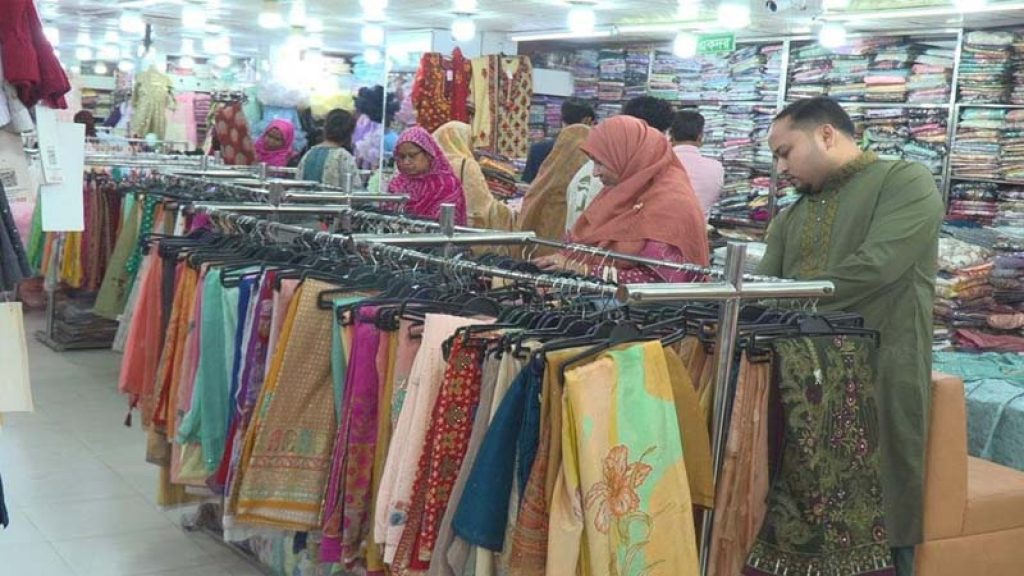

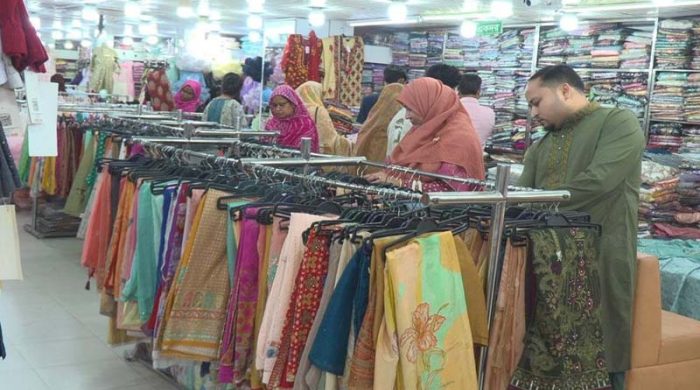
Traders say that it is no longer possible to sustain business by selling only silk. Production costs have increased several times, but buyers are looking for products at relatively low prices. As a result, shops are having to stock other products to sustain business.
Saidur Rahman, manager of Sapura Silk Mills Limited, said, “It has become difficult to run a business depending on silk now. Even though the cost of production has increased, the market is not getting the price accordingly. As a result, we are having to add non-silk products to sustain the business.”
It is known that once upon a time, the silk industry of Rajshahi was a complete economic cycle. Mulberry farmers, silkworm farmers, cocoon producers, yarn manufacturers, weavers and traders; all were part of the same chain. Almost every step of that cycle has become weak today.
According to the Bangladesh Silk Development Board, the country has a demand of about 400 tons of silk yarn annually. But only 40 to 42 tons are being produced locally. As a result, a large part of the market depends on foreign imports.
Zahurul Islam, general manager of Rajshahi’s traditional Usha Silk, said that the Silk Development Board has not been able to effectively keep the production system running. As a result, it is forced to import yarn from abroad to meet local demand. He said that five years ago, silk yarn that was available for 3-4 thousand taka per kg, now has to be purchased for about 9 thousand taka. This has also increased the production cost of silk fabrics several times.
The price hike has also affected the market. A decade ago, a silk saree that could be purchased for 3-4 thousand taka, now the price of the same quality saree has reached 9-10 thousand taka. As a result, a large section of the middle class is moving away from buying silk.
Mulberry cultivation has also faced a crisis. This cultivation was once the main source of income for many farmers in the northern region. But due to low profits, high labor, and lack of necessary support, farmers are gradually giving up mulberry cultivation. In 2015, the area of mulberry cultivation was 148.5 acres. In 2024, it decreased to 137.61 acres.
Abdul Awal, a mulberry farmer from Charghat Upazila of Rajshahi, said his ancestors also used to cultivate mulberries. But due to low profits and lack of government incentives, he has now reduced his cultivation considerably.
According to the Bangladesh Silk Industry Owners Association, 70 out of 76 private silk factories in the Rajshahi BSCIC industrial area are currently closed. Those concerned see the shortage of raw materials as the main reason for this.
Dr. Aminuzzaman Saleh Reza, professor of Zoology at Rajshahi University, said the closure of state-run silk factories, the entry of low-quality imported silk, and the weakness of the local production system have brought the industry to the brink of collapse.
He said, “To revive the silk industry, everything from silkworm egg production to cocoon, yarn, mulberry cultivation and marketing must be brought under an integrated model. It will be difficult for this industry to turn around unless farmers are trained, easy credit, technical support and fair prices are ensured.”
Bangladesh Silk Development Board Director (Finance and Planning) Dr. MA Mannan said that relying only on the government will not suffice, entrepreneurs will also have to come forward to revive the silk industry.
Chairman Editorial Board : Md. Shajahan Mia
Chief Editor : Md. Humayoun Rashid, Editor : Ayub Ali Sarder
Publisher : Tahmina Akter Saima
Office : Motaleb Mansion (5th Floor), 2 R. K. Mission Road, Dhaka -1203 Phone : 01711681147,01710453070
Email : morningobserver@gmail.com
All rights reserved © 2025 dailymorningobserver