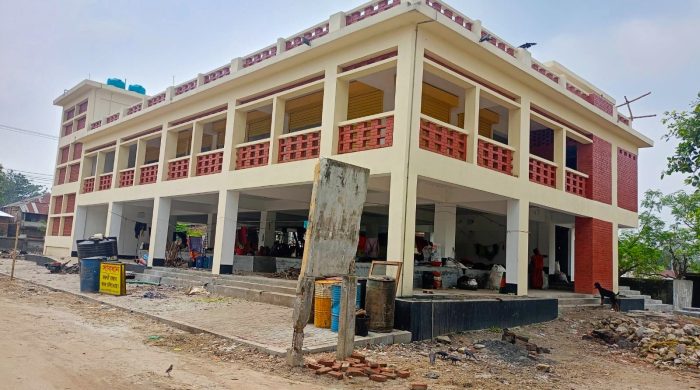

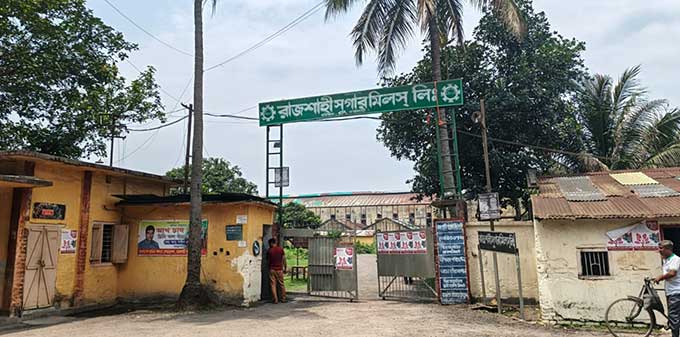
Once upon a time, the Rajshahi Sugar Mill was one of the driving forces of the economy of the sugarcane farmers and working people of the northern region. The mill’s wheels were powered by the sugarcane produced by local farmers, and the livelihood of thousands of people was built around that mill. But over time, that traditional industrial enterprise has now collapsed under the weight of losses. The crisis surrounding this sugar mill is gradually intensifying due to increasing production costs, sugarcane shortage, old machinery, weak management, and lagging behind in competition with imported sugar in the market.
Authorities said that for the last few years, the expected income from sales has not been generated compared to the production costs. The government has to provide regular subsidies to keep the mill running. However, due to the decrease in sugarcane collection during the season, production at full capacity is not possible. The cost of each kilogram of sugar produced in it is much higher than the market price, which has become a major reason for the losses.
Sources said that in the last five years, this mill was operational for a total of 173 days and it incurred a financial loss of 304 crore taka. According to the calculation, the average loss per day while the mill was operating was 150 million taka. According to the information available, the mill was operational for 19 days in the 2021-22 fiscal year and incurred a loss of 63 crore taka. In the next fiscal year, the loss in 21 days was the same as the previous year. In the next 2023-24 fiscal year, the loss in 35 days stood at 66 crore, in the 2024-25 fiscal year 69 crore and in the latest current 2025-26 fiscal year, the loss was about 70 crore taka.
When asked about this, Jamal Hossain, General Manager (Finance) of the Sugar Mill, said, “We are not getting the amount of sugarcane required for our mill. Sugarcane farmers are selling sugarcane to molasses traders at higher prices outside for higher profits. Our mill needs 140,000 sugarcane in 3 months, which we are not getting in sufficient quantity. The mill is also closed due to this sugarcane crisis. In addition, our mill is about 65 years old. The cost of repairing old machinery has also increased. That is why the amount of financial loss is increasing.”
According to the information received, in the last five years, about 11 thousand metric tons of sugar have been produced from sugar mills. In the latest fiscal year 2025-26, sugar production was 3 thousand 172 metric tons. In the fiscal year 2024-25, 3 thousand 567, in the fiscal year 2023-24, 1 thousand 865, in the fiscal year 2022-23, 1 thousand 356, and in the fiscal year 2021-22, sugar production was 1 thousand 318 metric tons. The concerned people said that in the latest fiscal year 2025-26, the sugar mill spent about 350 taka on producing each kg of sugar and it was sold for 125 taka. As a result, the financial loss stood at about 70 crore taka.
Saying that farmers and workers have lost interest in sugarcane cultivation at present, Sugar Mill Assistant Manager (Warehouse) Khandaker Abdul Matin said, “People are not interested in cultivating sugarcane now. Even if three-four crops are grown in a year, planting sugarcane does not yield any profit after the land bears fruit once. Also, due to economic uncertainty, farmers are turning to other crops. As a result, we are not getting enough sugarcane for our mill. If sugarcane cultivation is increased again in our region and sugarcane production is higher, then I think our mill will return to its glory days.” Information from the sugar mill also reveals that 60,620 metric tons of sugarcane were threshed in the 2025-26 fiscal year, which is not enough for the sugar mill. In the previous year, 70,720 metric tons of sugarcane were threshed in the 2024-25 fiscal year, 42,712 in the 2023-24 fiscal year, 26,044 in the 2022-23 fiscal year, and 24,03 metric tons of sugarcane were threshed in the 2021-22 fiscal year. Which is one-fourth of the sugar mills’ needs.
There were 16 sugar mills in Bangladesh. Due to continuous losses, the government closed six sugar mills in 2020. At that time, there were rumors that Rajshahi Sugar Mills would also be closed. Due to this, fertilizers, seeds, pesticides, and other agricultural inputs were sent from Rajshahi Sugar Mills to other sugar mills to supply farmers. This made farmers lose interest in the future prospects of sugarcane cultivation. This had an adverse effect on Rajshahi Sugar Mills. Therefore, sugar production decreased in the last five years due to the sugarcane crisis.
Meanwhile, against 1247 posts, Rajshahi Sugar Mills currently has 35 officers and employees and the remaining 545 employees and workers (permanent and temporary). This ancient institution is also facing a crisis with so many officers and employees. Masud Rana, president of the Workers’ and Employees’ Union of Rajshahi Sugar Mills Limited, said, “The mill is on the verge of closing due to sugarcane shortage and low manpower. We have 1247 posts here where 450 people are working. Sugar production is not possible without skilled workers and employees. But we are losing skilled workers and employees day by day. The reason is that our mill does not run all year round. Also, there are no panmen, fitters, or necessary mechanics for sugar production. The sugar mill is repeatedly incurring losses while drawing interest. I think government action is needed in this regard.” An official related to the sugar mill said on condition of anonymity, “There is no alternative to technological modernization, reducing production costs, and encouraging farmers to cultivate sugarcane to make the mill profitable. We also need to pay attention to the production of by-products.”
Rajshahi Sugar Mills Managing Director Humayon Kabir said, “Sugar mills are running with government subsidies. Our mill is seasonal. It runs for two to three months every year during winter. Sugarcane production in our region has decreased. Basically, due to low profits from sugarcane, farmers are turning to other profitable crops. And the company is facing losses because the cost of production is not increasing at the same rate as the price.”
The sugar mill, which was once the lifeblood of the area’s economy, is now struggling to survive. Locals believe that if proper planning and effective steps are not taken, the traditional Haryan Sugar Mill may become just a part of memory one day.
Chairman Editorial Board : Md. Shajahan Mia
Chief Editor : Md. Humayoun Rashid, Editor : Ayub Ali Sarder
Publisher : Tahmina Akter Saima
Office : Motaleb Mansion (5th Floor), 2 R. K. Mission Road, Dhaka -1203 Phone : 01711681147,01710453070
Email : morningobserver@gmail.com
All rights reserved © 2025 dailymorningobserver