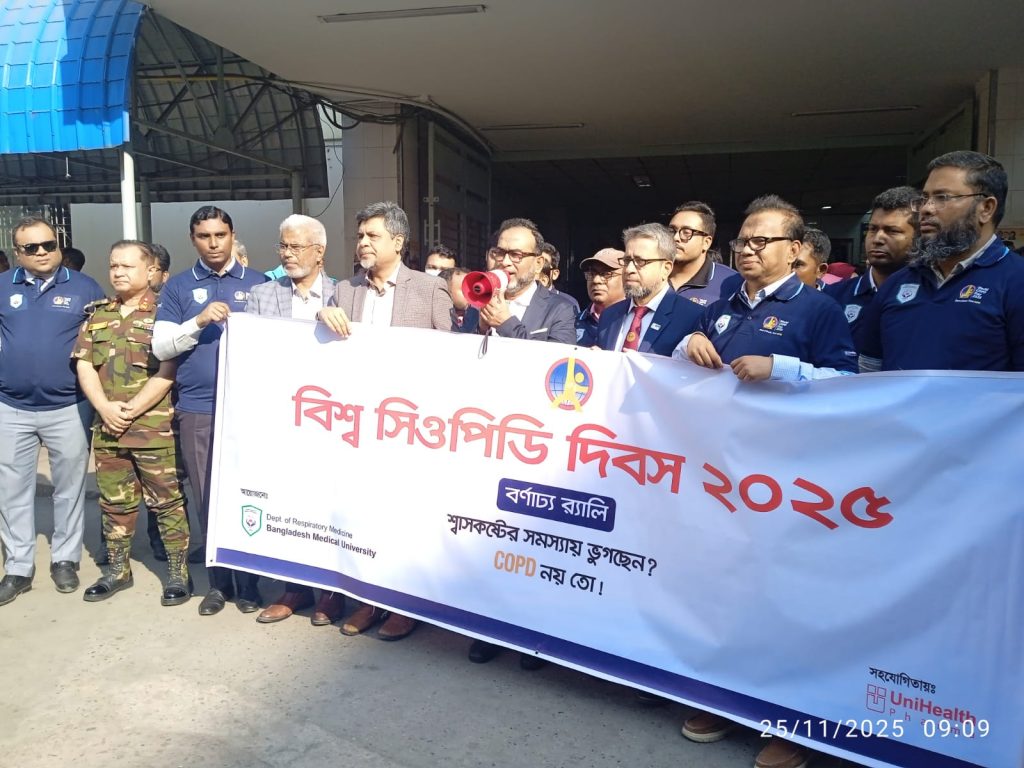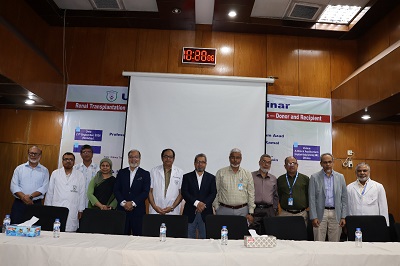

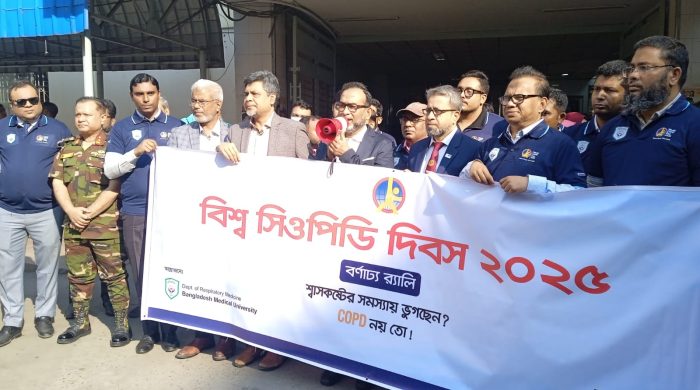
A public awareness rally and discussion meeting was held at Bangladesh Medical University (BMU) on the occasion of World COPD Day 2025 on Tuesday, November 25, 2025. Vice Chancellor Professor Dr. Md. Shahinul Alam was present as the chief guest in this event organized by the Department of Chest Diseases (Respiratory) of BMU. On the occasion of the day, a large-scale rally was taken out from the Cabin Block of BMU and balloons and pigeons were released. Later, a round table discussion titled ‘COPD: The Hidden Public Health Crisis’ was held at Shaheed Dr. Milton Hall. The guest of honour at the discussion was Associate Professor Dr. Md. Zahirul Islam Shakil, President of Chest and Heart Association Bangladesh. There, Pro-Vice Chancellor (Administration) of BMU, Professor Dr. Md. Abul Kalam Azad, Pro-Vice Chancellor (Research and Development) Professor Dr. Mujibur Rahman Howlader, Registrar Professor Dr. Md. Nazrul Islam, Director (Hospital) Brigadier General Irteka Rahman, Professor of Internal Medicine Department Dr. Md. Abdul Quader, Professor Dr. Kazi Momtaz Uddin Ahmed, Director of NIDCH Professor Dr. Md. Delwar Hossain, Head of Respiratory Medicine Department of DMC Professor Dr. Adnan Yusuf Chowdhury, Secretary General of CHAB Dr. Golam Sarwar Liaquat Hossain Bhuiyan, Respiratory Department Dr. Rajshis Chakraborty and others spoke. The program was presided over by Professor Dr. Shamim Ahmed, Chairman of the Department of Respiratory Medicine. The program was moderated by Dr. Manal Mizanur Rahman. The Holy Quran was recited by Dr. Kabirul Islam. Md. Shamim Alam Khan, Executive Director of Unihealth Pharma, also expressed his gratitude.
In his speech as the chief guest, Vice Chancellor Professor Dr. Md. Shahinul Alam said, public awareness must be created to prevent COPD. Initiatives must be taken to create necessary guidelines and policies for the prevention and treatment of COPD. Education and research activities on COPD need to be strengthened. In the field of research, it must be remembered that research that is useful for the needs and welfare of the people and patients must be focused on. Another thing that must be remembered in the field of research is that spending a lot of money on research does not necessarily mean that it will be a great research or will benefit the patients and the people. There are many examples where the results achieved through low-cost research are contributing to the great welfare of the people and the people. He also said, COPD is now a deep public health crisis in Bangladesh. There will be no solution without controlling smoking, air pollution, indoor smoke. We must prioritize COPD in medical education, research, policymaking and national healthcare. Ensuring rapid identification, community-level screening, and modern medical facilities are the biggest challenges of the present time. Today’s event will play an active role in future research, residency training, pulmonary rehabilitation centers, and the creation of disease registries.
In his speech as the honored guest, Dr. Md. Zahirul Islam Shakil, President of Chest and Heart Association Bangladesh, said, “There are many opportunities to work to prevent COPD. It is possible to prevent COPD if we work together. At the same time, research activities should also be given importance.”
BMU’s Pro-Vice Chancellor (Administration) Professor Dr. Md. Abul Kalam Azad said, “To prevent COPD, a coordinated and national-level program should be taken with emphasis on avoiding smoking, reducing air pollution, and addressing all risks. Mothers should be informed about the correct rules for using cooking stoves in villages. Attention should also be paid to ensuring that COPD patients receive appropriate treatment based on guidelines.”
Pro-Vice Chancellor (Research and Development) Professor Dr. Mujibur Rahman Howlader said, it is important to make the public aware of the health system. Prevention of environmental pollution and smoking cessation are essential to prevent COPD. Research activities must be continued for development and disease prevention.
Professor Dr. Shamim Ahmed, Chairman of the Department of Respiratory Medicine, said, “We must remember that COPD is preventable. Prevention of COPD is the greatest strength. Working together, we can reduce the burden of this disease by almost half. Today’s seminar and discussion have made it clear that integrated research, patient education, smoking control and ensuring modern treatment are essential to combat COPD. BMU is ready to lead in this regard. The recommendations of today’s discussion will be incorporated into next year’s action plan.”
Other speakers said that data collection and screening at the district and upazila levels are essential to know the true burden of COPD. National database and multicenter research on COPD should be our priority. Public awareness and safe cooking environment are very important in preventing indoor air pollution in women. COPD should be given more importance in medical education and intern training. Preventing smoking in the young generation will reduce the burden of COPD in the future. Ensuring guideline-based treatment in COPD management is now essential. Establishing pulmonary rehabilitation units is also the need of the hour. If spirometry is introduced in community clinics, early diagnosis will increase manifold. Special plans are needed to address the increasing complexity in COPD management in the elderly population. A model of COPD management needs to be created across the country. New inhaler technology and patient education are the main tools in controlling COPD. Awareness campaigns need to be strengthened across the country. It is important to create skilled health workers to identify COPD at the initial stage. Improving hospital-based COPD care pathways will greatly reduce acute exacerbations. If vaping and smoking among young people are not controlled, COPD will increase further in the future, so this issue must be given importance.
The speakers also said that COPD is increasing rapidly in Bangladesh. Smoking, air pollution and indoor smoke are the main risks. Spirometry is essential at the initial stage. Guideline-based treatment and rehabilitation will improve the quality of life. Screening is needed at the community level, and a coordinated effort by universities, hospitals and national organizations is needed. At the end of the discussion, the speakers announced that Bangladesh Medical University and Chest and Heart Association will undertake a stronger national program against COPD in the future. Edited by Dr. Saiful Azam Ranju.
Chairman Editorial Board : Md. Shajahan Mia
Chief Editor : Md. Humayoun Rashid, Editor : Ayub Ali Sarder
Publisher : Tahmina Akter Saima
Office : Motaleb Mansion (5th Floor), 2 R. K. Mission Road, Dhaka -1203 Phone : 01711681147,01710453070
Email : morningobserver@gmail.com
All rights reserved © 2025 dailymorningobserver