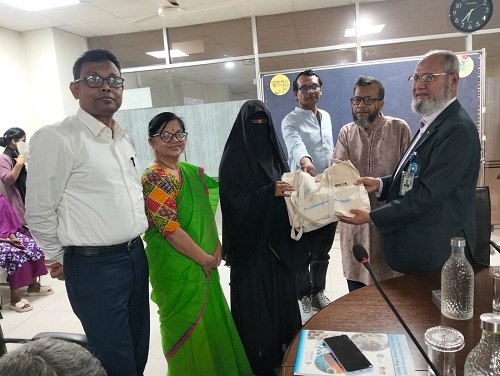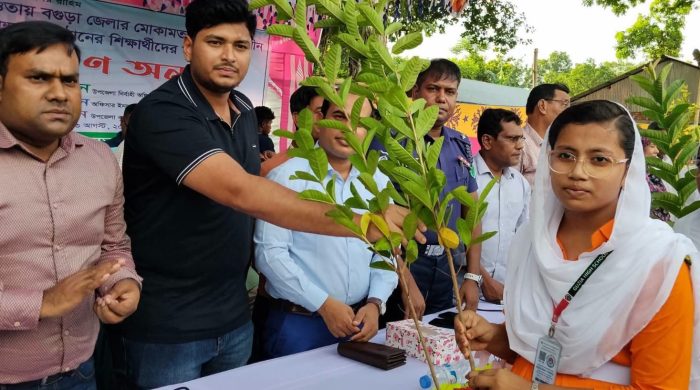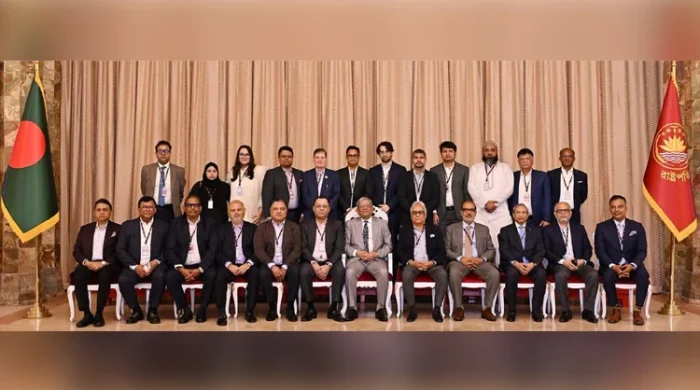

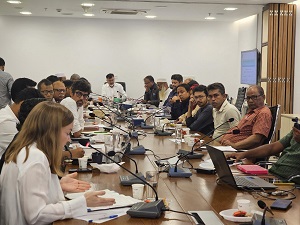
Tuesday, August 18, 2026 The “Knowledge Exchange” event of the Re WET (Climate Impacted Dwellers-Led Agro-ecological Stewardship for Restoring Wetlands) project was held in Dhaka today to showcase the experience of agro-ecological-based initiatives for restoring wetlands led by climate-impacted communities. The event, jointly organized by River and Delta Research Consultants Limited (RDRC) and Dhaka North City Corporation (DNCC), was held at the Mini Auditorium on the sixth floor of Dhaka North City Corporation. The event highlighted the experiences, lessons learned and future prospects of community-led initiatives, urban agriculture, nature-based solutions and local stakeholder engagement in the restoration, biodiversity conservation and sustainable management of Gulshan-Banani Lake. In addition, joint initiatives, opportunities for cooperation and future plans for the future restoration and sustainable management of Gulshan-Banani Lake were also discussed. The event was presided over by Brigadier General Syed Rakibul Hasan, PSC, Chief Engineer, Dhaka North City Corporation, and the chief guest was Md. Shafiqul Islam Khan , Honorable Administrator , Dhaka North City Corporation . The keynote address was presented by E. Fadul Haque, Co-Lead ( Re-Weight ) and Assistant Professor– Smith College, USA. Beth Downey, Program Manager, International Institute for Environment and Development, (IIED), UK, was present as a special guest. Also present were Muhammad Asaduzzaman, Chief Executive Officer, ( Deputy Secretary), ( Additional Responsibilities); Mohammad Abul Kashem, Supervising Engineer, Environment, Climate and Disaster Management Circle, Dhaka North City Corporation; Commodore Mohammad Humayun Kabir, Chief Waste Management Officer, Dhaka North City Corporation; Abul Hasnat Md. Ashraful Alam, Supervising Engineer, Mechanical Circle, Dhaka North City Corporation; Md. Wahidul Islam Murad, Supervising Engineer and Project Director, Dhaka WASA; Md. Aminur Rasul, Treasurer, River and Delta Research Consultants Limited (RDRC); Rafiqul Islam Azad, Former President, Dhaka Reporters Unity; The main partners of the Re-Wet project from Abad were Urban Abad Mentor Md. Shaheduzzaman Shyamal, Hawa Khanam and Sultana Raihan and Urban Abad Farmer Md. Rafiqul Islam; Kazi Akif, former Project Manager (Re-Weight) and many others. The program was hosted by Asif Mainur Chowdhury, Project Manager (Re-Weight). During the keynote presentation, Ifadul Haque, Co-Lead (Re-WEAT) and Assistant Professor, Smith College, USA, said that Jeri-WEAT is essentially an evidence-based urban wetland restoration model, through which the environmental, social and community-based problems of urban wetlands are being addressed in an integrated manner. He highlighted the importance of urban wetlands in biodiversity conservation, ecosystem balance , food security and overall human well-being. He said that under Re-WEAT, research and evidence-based information is first being collected and practical activities are being taken based on that information. In this context, he gave the example of the demonstration ground or “enclosure” and said that 23 types of toolkits are being experimentally applied by constructing a semi-circular bamboo structure about 150 feet long. In addition to fish farming, new ecological habitats are being created there by establishing wetland-friendly vegetation and floating gardens. The main article also reveals that as a result of these activities, the presence of birds, various insects, reptiles and other animals, in addition to fish, is increasing. Through this, opportunities are gradually being created to restore the biodiversity and ecosystem of the wetland, and at the same time, the issue of livelihood and food security of the community is also being linked with environmental development. RDRC Treasurer Mohammad Aminur Rasul said that life and nature have returned to Gulshan-Banani through the REWEAT project. As a result , there have been positive changes in the environment and biodiversity of the water body. He said that if the officials associated with DNCC guide this initiative more effectively and take ownership of the project, then it is possible to spread the REWEAT model across the country, not just limiting it to a specific area.
Chairman Editorial Board : Md. Shajahan Mia
Chief Editor : Md. Humayoun Rashid, Editor : Ayub Ali Sarder
Publisher : Tahmina Akter Saima
Office : Motaleb Mansion (5th Floor), 2 R. K. Mission Road, Dhaka -1203 Phone : 01711681147,01710453070
Email : morningobserver@gmail.com
All rights reserved © 2025 dailymorningobserver