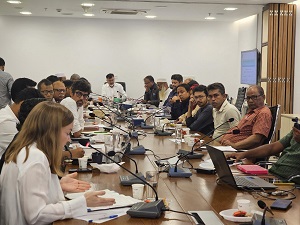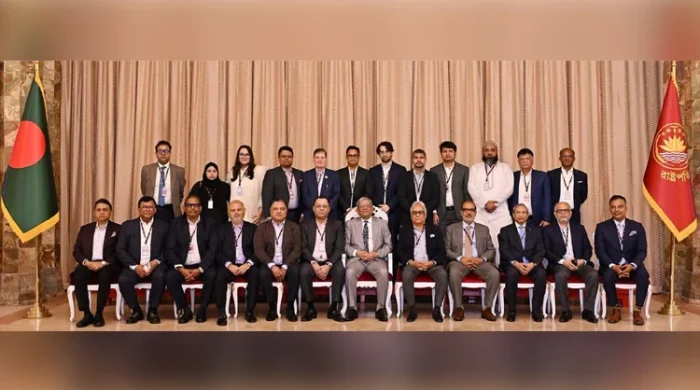

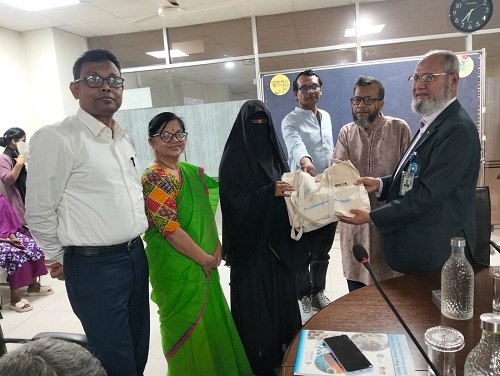
Coastal Development Partnership (CDP) organized a “Dialogue on Urban Climate Resilience” on Thursday, August 27, 2026, at the NGO Affairs Bureau Conference Room, Agargaon. The dialogue was attended by Dr. Mohammad Zakaria, Director General (Secretary), NGO Affairs Bureau, Prime Minister’s Office, Agargaon, Dhaka, as the chief guest. Mihir Biswas, Chairman of CDP presided over the event. Syed Jahangir Hasan Masum, Executive Director of CDP, was the main discussant and presented the paper. Barrister Md. Khalilur Rahman Khan NDC was present as the special guest. Shah Israt Ajmeri, Chairman, Children Watch Foundation, along with officials of various NGOs and environmental organizations, journalists and other guests were also present as special guests. Each of them gave valuable speeches from their respective positions. A human rights-based, non-governmental and non-profit voluntary organization dedicated to protecting the environment and human rights of Bangladesh. CDP works to establish social peace, human rights, development equity, effectiveness, sustainable poverty alleviation, good governance, climate resilience, food sovereignty and people’s empowerment in Bangladesh through capacity building, research advocacy and network development of local communities, civil society, grassroots organizations. The organization was born on January 1, 1997, by the late Ashraful-ul-Alam (Tutu), a freedom fighter, environmental activist and one of the organizers of the southwestern coastal region of Bangladesh. CDP worked as the first partner organization of the Climate Change Project in Bangladesh in 2001, and since 2004, has been working to bring climate resilience in development activities to the doorsteps of the people as a human rights-based service. Since 2010, the Coastal Development Partnership has been implementing projects in Bangladesh’s climate-vulnerable districts to continuously increase the capacity of local communities to cope with the impacts of climate change. In 2002, CDP was approved by the NGO Bureau. The German development organization Bread for the World was established on December 12, 1959, in cooperation with the Protestant Church. One of the goals of Bread for the World is to improve and empower local communities by ensuring their fundamental rights. Bread for the World works in 112 countries to establish food security, human rights, climate resilience, sustainable development and social justice. Bread for the World has been providing financial and technical assistance as the main development partner of the Coastal Development Partnership (CDP). Its values are empowerment, mutual respect, equality, fairness, peace, dignity, integrity, non-discrimination, continuity, courageous conviction and solidarity with the people’s struggle. Its vision, mission and goals are: To build a prosperous, environmentally friendly and value-driven progressive society free from all forms of discrimination based on race, religion, color or gender. To increase the capacity of deprived and discriminated people, communities, public organizations, grassroots NGOs and local civil society to achieve development equity and climate tolerance. To ensure social peace, human rights, development equity, and sustainable poverty alleviation through people’s empowerment.
Chairman Editorial Board : Md. Shajahan Mia
Chief Editor : Md. Humayoun Rashid, Editor : Ayub Ali Sarder
Publisher : Tahmina Akter Saima
Office : Motaleb Mansion (5th Floor), 2 R. K. Mission Road, Dhaka -1203 Phone : 01711681147,01710453070
Email : morningobserver@gmail.com
All rights reserved © 2025 dailymorningobserver