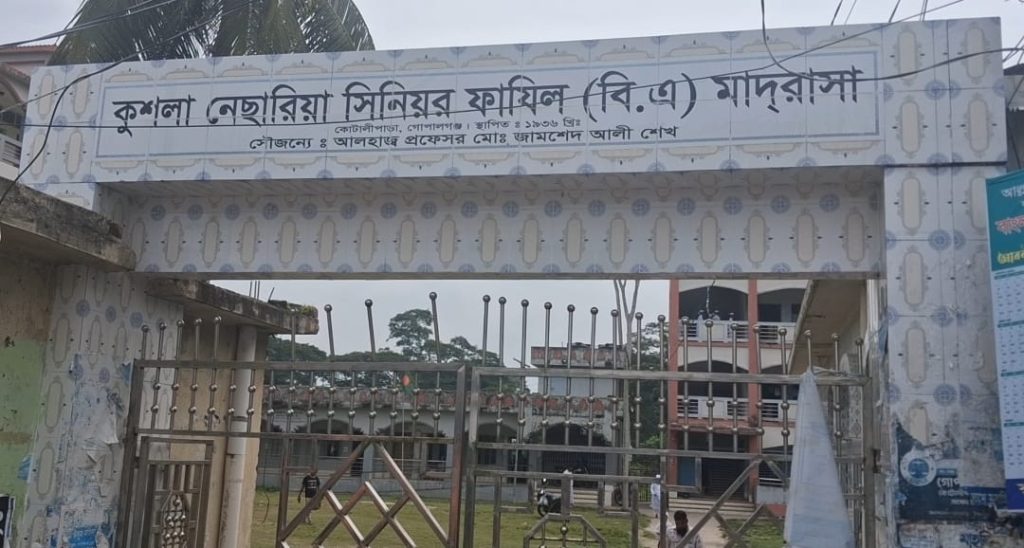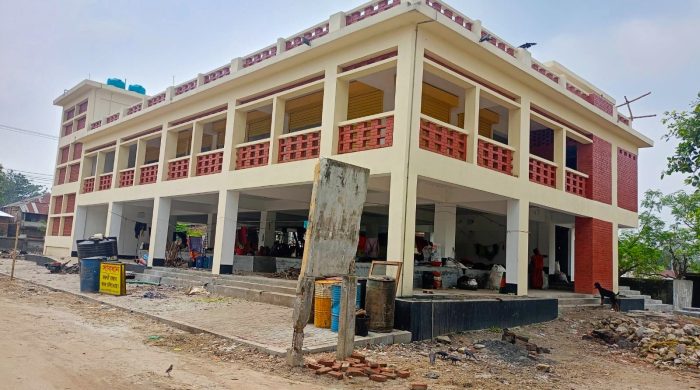

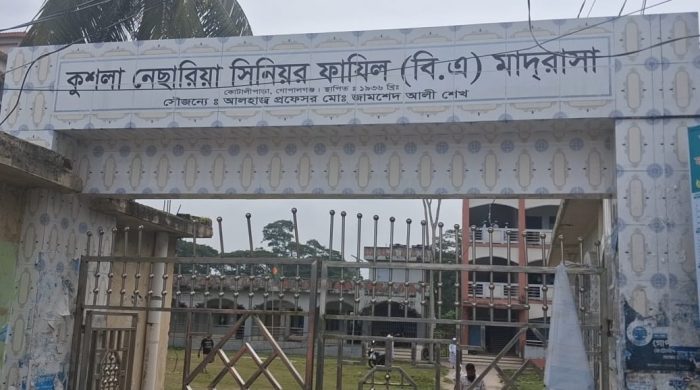
Allegations have arisen regarding the construction of shops in Kotalipara, Gopalganj, that obstruct the washroom windows, water supply lines, drains, septic tank, and veranda windows of a madrasa.
Madrasa authorities claim that the normal environment and infrastructure of the institution are being compromised by five shops built on a plot of land leased from the Gopalganj District Council.
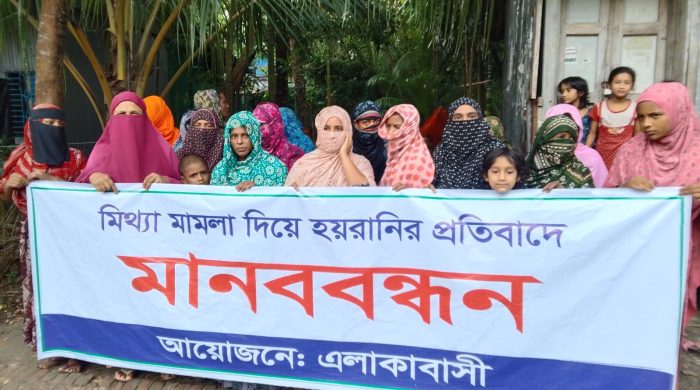
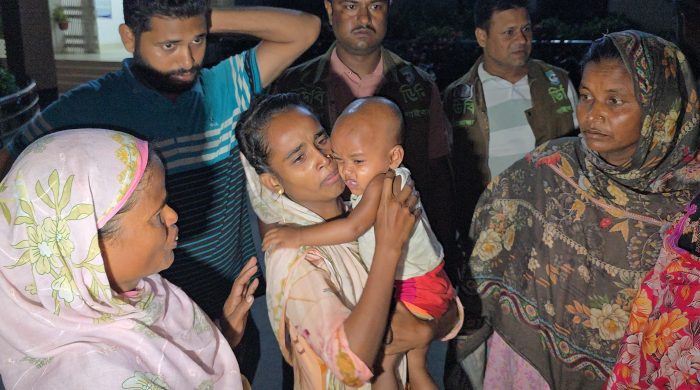
This situation has sparked outrage among madrasa students and local residents, while a conflict has emerged between the madrasa authorities and the shop developers.
The incident occurred in the Kushla Bazar area of the upazila. Locals allege that an influential group of businesspeople leased the roadside land from the Gopalganj District Council and constructed the five shops under the cover of darkness. However, the ownership of the land itself is in dispute. Madrasa authorities claim they believed the land belonged to the District Administration, whereas the businesspeople assert that the District Council leased the land to them in accordance with regulations.
This raises questions: if the land belongs to the District Administration, how did the District Council lease it out? Conversely, if it belongs to the District Council, why did the madrasa authorities believe it was District Administration property?
Locals allege that the construction of these shops has not only obstructed madrasa infrastructure but also raised concerns regarding roadside movement and safety.
A site visit revealed that five shops have been constructed in a narrow space between the western side of the new Kushla Nesharia Senior Fazil Madrasa building and the eastern side of the LGED road. Madrasa authorities allege that these shops obstruct the madrasa’s washroom and veranda windows, water supply lines, drains, and parts of the septic tank.
Baker Hossain, the principal of the madrasa, said, “The madrasa is an MPO-listed institution with over six hundred students. Due to a shortage of space, a new building was constructed through the Education Engineering Department. Before the construction, there were two madrasa-owned shops and three privately owned shops situated beside the road and the original building; these shops were removed during the construction process.”
He added, “After the new building was completed, the available space became even more restricted. We had always understood the land between the road and the building to belong to the district administration. However, we suddenly discovered that five individuals had obtained a lease for that land from the District Council and constructed five shop units there under the cover of darkness.”
The principal further stated, “The construction of these shops has blocked access to various madrasa facilities, including the toilets, veranda windows, water supply pipes, drains, and the septic tank. Now, the toilets become pitch-dark during power outages, and the blockage of water pipes has halted the water supply, causing significant difficulties for both teachers and students.”
The madrasa authorities argue that allocating land without considering the infrastructure of an educational institution and the amenities used by students is a matter of serious concern for the educational environment. They maintain that the relevant authorities should have conducted an on-site survey and verified the location of the madrasa’s structures before allocating the land.
Speaking on condition of anonymity, a local businessman remarked, “The big question now is how it was even possible to allocate land for shops in a way that obstructs the facilities of an educational institution. If the District Council did indeed allocate the land, there needs to be clarity regarding their ownership rights and their authority to grant such a lease.”
He further added, “LGED roads typically have shoulders and slopes extending beyond the paved surface. Constructing structures right up against the road raises concerns regarding the safety of pedestrians and vehicles. Therefore, it is necessary to investigate whether these shops have been built within the designated road boundaries.”
However, Buddhimatta, a trader who was allocated a shop, stated that he had been conducting business there previously. He said, “I was already doing business here. At that time, I used to make annual payments to the Upazila Land Office in accordance with the rules, believing the land belonged to the District Administration. When the new madrasa building was being constructed, I relocated my shop elsewhere to facilitate the construction.”
He continued, “The madrasa authorities had assured me that arrangements would be made to re-establish the shop once the building was completed. Later, after construction finished, I learned that the land actually belonged to the District Council. I then applied to the District Council and secured an allotment. I was allocated a spot on the opposite side rather than the original location, and the size of the allotted space is smaller than before.”
Buddhimatta alleges that some individuals who had not previously conducted business there managed to secure spaces by leveraging their influence, raising questions about the transparency and fairness of the allotment process.
Local sources indicate that the recipients of the allotments include Hafizul Islam, President of the Kushla Bazar Traders’ Association; a relative of local BNP leader Faruk Hossain; and Milon Fakir, a dredger business owner.
Some locals have alleged that these three individuals secured the land allotments by utilizing their political and organizational influence.
Regarding this matter, Hafizur Rahman, President of the Kushla Bazar Traders’ Association, said, “Sixteen individuals applied to the District Council for the land. Out of them, five of us were granted allotments. We constructed the shop structures legally after receiving the allotment.”
Addressing the issue of the shops obstructing madrasa structures, he stated, “The District Council allocated the land to us, and we built structures on it. If this obstructs the structures of another institution, there is nothing we can do about it.”
Meanwhile, resentment over the construction of these shops has also spread among the madrasa students. A tenth-grade student said, “Shops have been constructed in a way that blocks the windows, water lines, and other installations of the educational institution. This is causing us problems. We fail to understand how the land was allocated in a manner that obstructs the institution’s facilities. If the shops are not removed and the land allocation cancelled immediately, we will launch a protest.”
According to locals, the issue is no longer confined to a dispute between the Madrasa and the traders; it now involves questions regarding the ownership of government land, the legality of the allocation, road safety, and the maintenance of a conducive environment for the Madrasa.
They question how the District Council could allocate the land if it actually belongs to the District Administration. Conversely, if the land belongs to the District Council, why was there confusion regarding its ownership for so long?
Questions have also been raised as to whether the relevant authorities conducted an on-site survey and measurement before allocating the land for the five shops. Did they verify the locations of the Madrasa building, windows, water lines, drains, and septic tanks? Were the boundaries and safety aspects of the LGED road taken into consideration?
On September 5, Sharif Rafiquzzaman, the Administrator of the Gopalganj District Council, visited the site to inspect the situation firsthand. He spoke with the traders who had secured the allocation and the Madrasa teachers, assuring them that the matter would be resolved.
Kotalipara Upazila Nirbahi Officer (UNO) Saif-ul-Arefin said, “On paper, the land belongs to the District Administration. However, I have also heard that the land actually belongs to the District Council. The matter is currently under review. Nevertheless, constructing shops that obstruct the building’s facilities is unfortunate.”
He added, “I have discussed the matter with higher authorities. I hope a satisfactory solution will be reached.”
The Madrasa authorities, students, and local residents insist that removing the constructed shops is essential, citing concerns for the safety of the building and pedestrians using the road.
Chairman Editorial Board : Md. Shajahan Mia
Chief Editor : Md. Humayoun Rashid, Editor : Ayub Ali Sarder
Publisher : Tahmina Akter Saima
Office : Motaleb Mansion (5th Floor), 2 R. K. Mission Road, Dhaka -1203 Phone : 01711681147,01710453070
Email : morningobserver@gmail.com
All rights reserved © 2025 dailymorningobserver