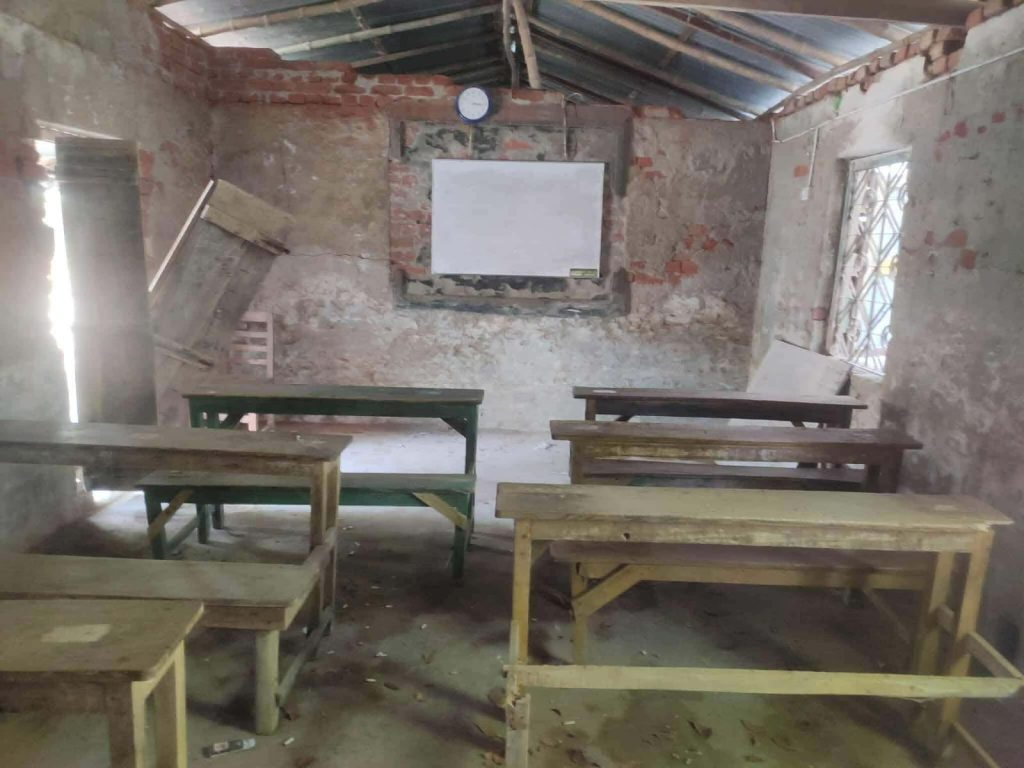

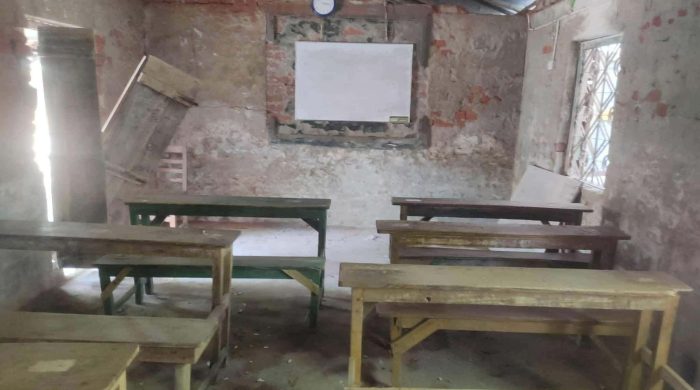
The school, which was once the main source of education for a village, is now a cause of concern for students after 54 years. The plaster on the walls has fallen off, rods and red bricks have come out in some places. The old roof and structure have also lost their natural strength. When it rains, the roof leaks and water falls. About 200 students have to take lessons every day in such a dilapidated structure.
This picture of Laskar Karulia Secondary School in Khulna’s Paikgachha Upazila has been around for a long time. Established in 1972 and registered as an MPO on January 1, 1985, the institution has played an important role in the expansion of education in the area, but it has lagged behind in infrastructure development. Although the scope of education of students has increased over time, the old building of the school seems to be in the same condition as before.
Signs of dilapidation have been seen in various places in the main building of the school. The plaster on the walls has fallen off and rods and bricks have come out. There are also concerns about the old structure of the roof. During rainy days, water seeps through the roof, disrupting normal teaching in the classrooms. As a result, there is concern about the safety of the students as well as their studies.
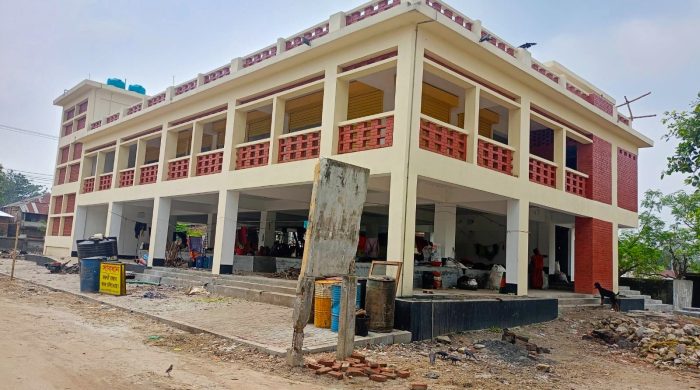
Sabera Khatun, a student, says, “Seeing the beautiful and safe building of another school, we also want to sit in such a classroom. On rainy days, water leaks through the roof. Then it becomes difficult to concentrate on studies.”
Sumi Akhter, another student, said, “It feels scary when taking classes in an old building. We want our school to be safe and beautiful too.”
Parents also agree with the students’ concerns. According to them, temporary renovations or repairs will not solve the problem permanently. What is needed is safe and sustainable infrastructure instead of dilapidated buildings.
The school’s headmaster, Mustaq Ahmed, said, “Coming to school every day with the responsibility of about 200 students is a matter of mental stress. The building is so old and risky that it cannot be solved by just whitewashing or patching. Although there are currently 12 teachers working in the school, seven posts are vacant. However, the safety of the students is a bigger issue than the shortage of teachers. This is our expectation that the concerned quarters will take the initiative to quickly construct a new and safe building after conducting a site visit.
The question of the local residents is, why do the students still have to take lessons in a dilapidated building even though a school has been spreading the light of education for 54 years? They demand that the school’s infrastructure should be inspected quickly and necessary measures should be taken without waiting for any accident.
Teachers, students, guardians and locals are now looking forward to effective steps by the concerned administration and the Department of Education and Engineering to ensure the safety and learning environment of about 200 students.
Chairman Editorial Board : Md. Shajahan Mia
Chief Editor : Md. Humayoun Rashid, Editor : Ayub Ali Sarder
Publisher : Tahmina Akter Saima
Office : Motaleb Mansion (5th Floor), 2 R. K. Mission Road, Dhaka -1203 Phone : 01711681147,01710453070
Email : morningobserver@gmail.com
All rights reserved © 2025 dailymorningobserver