

Although the ‘Smoking and Tobacco Products Use (Control) (Amendment) Act, 2026’ is considered a groundbreaking step in tobacco control, it is essential to take swift and effective action against all types of emerging tobacco products including e-cigarettes, vape, nicotine pouches, along with the effective implementation of the act to ensure the protection of public health, said honorable members of parliament, public health experts, researchers and representatives of anti-tobacco organizations.
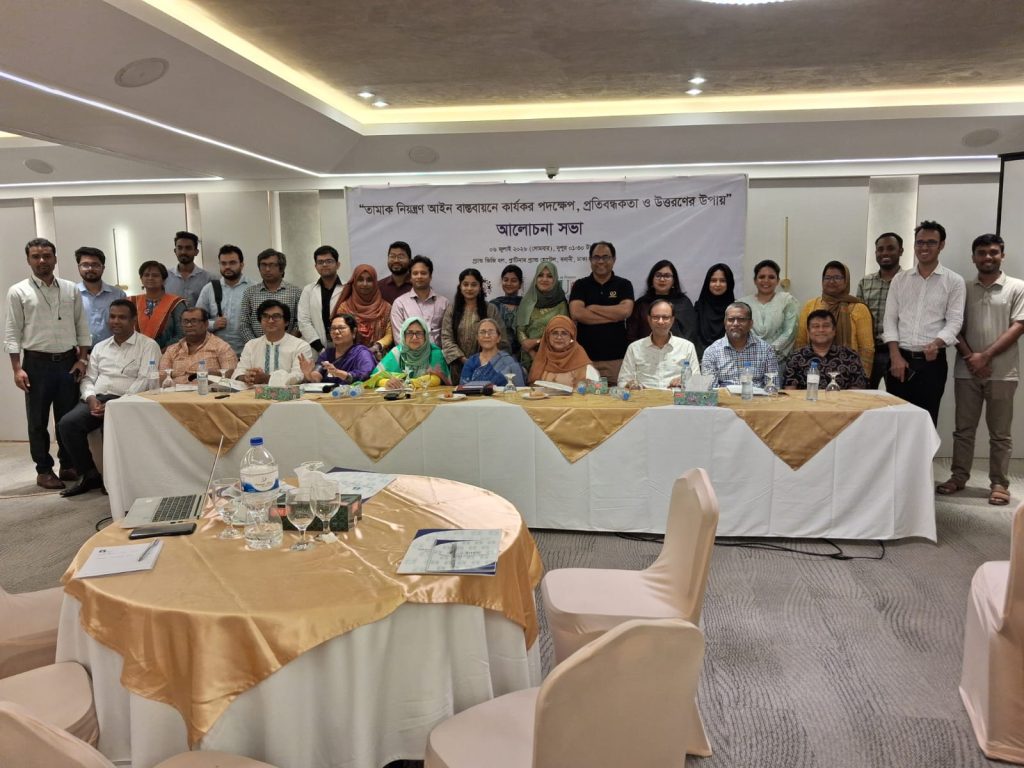
They made these remarks at a discussion titled “Effective Steps, Obstacles and Ways to Overcome the Tobacco Control Act” at a hotel in Banani, Dhaka, on Monday (July 6, 2026). The discussion was organized by the Tobacco Control and Research Cell (TCRC), Dhaka International University, Bangladesh Anti-Tobacco Alliance (BATA) and Anti-Tobacco Women’s Alliance (TABINAZ).
The meeting was chaired by Farida Akhtar, former advisor to the government of Bangladesh and executive director of UBINIG. Rasheda Begum Hira, MP for Women’s Constituency-3, and Bilkis Islam, MP for Women’s Constituency-7, were present as guests. Iqbal Masud, Director of Health Sector of Dhaka Ahsania Mission and Convener of BTCA, Shaheen Akhter Dolly, Executive Director of Nari Maitree, Syeda Ananya Rahman, Office Secretary of Bangladesh Anti-Tobacco Alliance and Head of Programs of Work for a Better Bangladesh (WBB) Trust, and Taifur Rahman, Public Health Specialist and Tobacco Control Specialist, were present as expert discussants. The meeting was moderated by Md. Bazlur Rahman, Associate Professor and Project Director of Tobacco Control and Research Cell (TCRC) of Dhaka International University. Director of Tobacco Control and Research Cell (TCRC) of Dhaka International University, Seema Das Seemu, delivered the welcome address and project coordinator of Dhaka International University (TCRC), Farhana Zaman Liza, presented the keynote address.
The speakers at the meeting expressed their sincere gratitude to the Bangladesh government for enacting the ‘Smoking and Tobacco Products Use (Control) Act, 2005 (Amendment 2026)’. At the same time, they said that although the amended law is an important milestone in tobacco control, its success will depend on effective implementation. To this end, the relevant ministries, local administrations, law enforcement agencies and public health-related institutions should identify existing obstacles in implementing the law at the field level and strengthen coordinated efforts. At the same time, the government should continue its efforts to regularly monitor the progress of the law implementation, increase public awareness and develop the capacity of the concerned officials.
The speakers expressed deep concern and said that the amended law has repealed the provision banning all types of emerging tobacco products including e-cigarettes, vape, nicotine pouches. As a result, these products have been practically released into the market without control, which can pose serious risks to public health as well as children, adolescents and young people of the country. Therefore, they urged the government to take immediate and effective policy and legal steps against all types of emerging tobacco products including e-cigarettes, nicotine pouches, to protect the youth from the trap of tobacco and nicotine addiction.
The speakers also said that tobacco and nicotine companies are specifically presenting tobacco and nicotine products to children, adolescents and young people in new forms, packaging and aggressive marketing strategies to expand their business. Although these products are presented as safe, modern or relatively less harmful through false propaganda, in reality these claims have no scientific basis. Rather, these products are pushing young people towards nicotine dependence and are also increasing the risk of using conventional tobacco products in the future. Enacting laws alone is not enough to create a tobacco-free generation; in addition to its effective implementation, effective policies must be adopted to prevent tobacco companies from interfering in the policy-making process.
The meeting made 5 recommendations for tobacco control. These recommendations are to strictly eliminate the manipulation and offer of tobacco companies; ban retail sale of cigarettes, mobile sales, and sale of tobacco products without a license; enact a separate law to prohibit the production, manufacture, import, export, transportation, sale, distribution, storage, and advertising of emerging tobacco products, including e-cigarettes and nicotine pouches; formulate a tobacco cultivation policy and tobacco tax policy, and quickly formulate legal regulations.
Chairman Editorial Board : Md. Shajahan Mia
Chief Editor : Md. Humayoun Rashid, Editor : Ayub Ali Sarder
Publisher : Tahmina Akter Saima
Office : Motaleb Mansion (5th Floor), 2 R. K. Mission Road, Dhaka -1203 Phone : 01711681147,01710453070
Email : morningobserver@gmail.com
All rights reserved © 2025 dailymorningobserver