
Every year, the citizens of Jessore Municipality have to suffer from waterlogging during the monsoon season. Every year, crores of taka are spent on constructing drains and hundreds of workers are employed to clean the drains, costing around two crore taka.
Moderate to heavy rains have caused waterlogging in various roads, markets, educational institutions and residential areas of the city. Residents of wards 5, 7 and 9 of the municipality have been the most affected.
Locals complain that despite development projects worth crores of rupees, the same pattern is being repeated year after year due to lack of planning, inadequate maintenance of drains, weak canal-drain connections, and indiscriminate dumping of waste in drains.
According to the municipality, the total length of drains in the 9 wards of Jessore Municipality is 251.96 kilometers. Of this, 49.22 kilometers are RCC drains, 69.25 kilometers are brick-built drains, five kilometers are pipe drains and 128.49 kilometers are unpaved drains. In other words, more than half of the total drains are still unpaved, which poses a major obstacle to rapid water drainage during the rainy season.
According to the municipality, 2.26 crore taka has been allocated for drain cleaning and maintenance in the current fiscal year. Of this, about 1.88 crore taka has already been spent. That is, about 83 percent of the total allocation has been spent. According to the calculation, an average of about 75 thousand taka is being spent annually to clean every kilometer of drain.
On the other hand, work is underway to construct about seven kilometers of new RCC drains in wards 5, 7, 8 and 9. The cost of this project is estimated at 20 crore 36 lakh taka, with the cost of constructing each kilometer of drain being about 2 crore 91 lakh taka. The municipal authorities claim that once the project is completed, waterlogging in these areas will be reduced to a great extent.
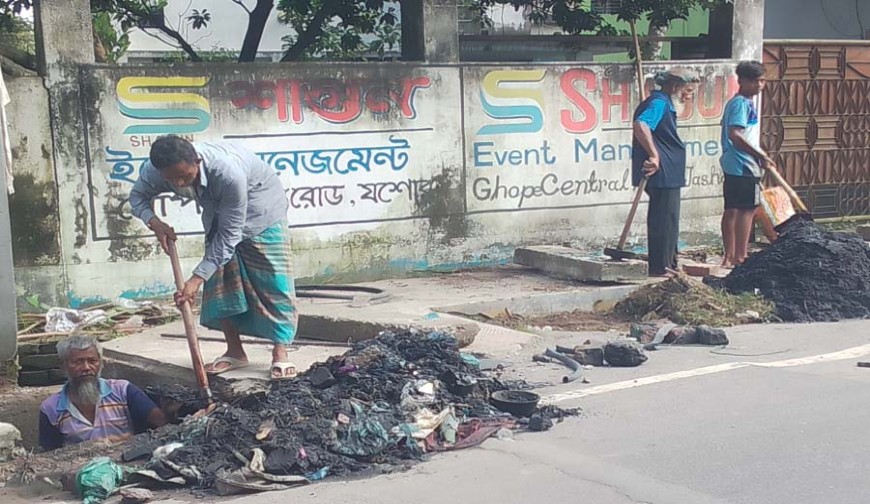
Uttam Kumar Kundu, administrative and information officer of the municipality, said that from November to March before the monsoon season, 150 to 160 workers are engaged in drain cleaning every day. If necessary, this number is increased to 200. Currently, 80 to 90 workers are cleaning drains every day. The daily wage of each worker is 500 taka.
He said that on Sunday (June 28), a total of 82 workers worked in 9 wards. Of these, six in ward 1 (costing 3,000 taka), eight in ward 2 (4,000 taka), six in ward 3 (3,000 taka), eight in ward 4 (4,000 taka), 16 in ward 5 (8,000 taka), eight in ward 6 (4,000 taka), 14 in ward 7 (7,000 taka), eight in ward 8 (4,000 taka) and eight in ward 9 (4,000 taka) worked. In total, 41,000 taka was spent on the attendance of the workers alone.
On Monday, the same number of workers, 82, were engaged in cleaning drains in the same wards. Another 41,000 taka was spent on the workers’ wages. As a result, against a total of 164 workers on Sunday and Monday, 82,000 taka was spent just on the attendance of the workers.
Based on this calculation, the current workforce can cost around 12.30 lakh taka per month and around 14.76 crore taka per year just on the wages of the workers. Apart from this, there are also expenses for waste removal, transportation, machinery, fuel and supervision.
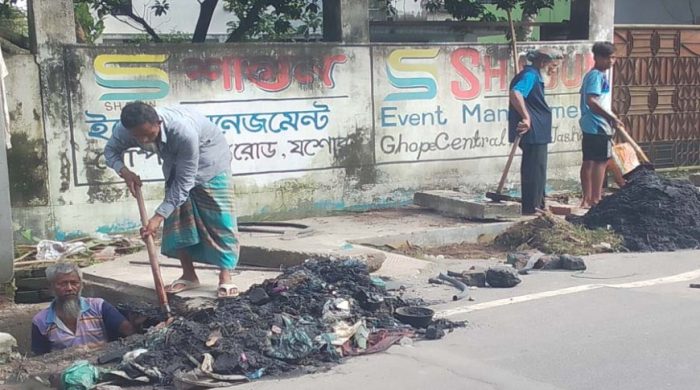
On-site visits to Khadki, Chanchra, Bejpara, Arabpur, Shankarpur, Railgate, Palbari and Bakchar areas show that the drain at Royal Mor in Palbari is filled with plastic, polythene, mud, weeds and rotten waste. The bottom of the drain in front of the Circuit House is filled with silt, almost blocking the flow of water.
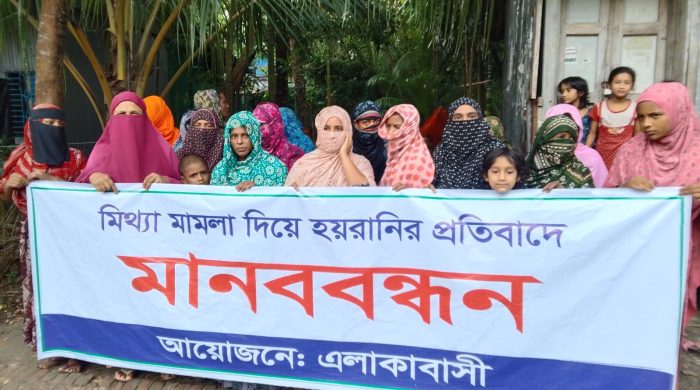
The residents of wards 5, 7 and 9 are the worst sufferers. Roads in these areas remain waterlogged for a long time after rains. Many have to wade through water to reach their workplaces, schools, colleges and markets. Businessmen are also facing financial losses due to waterlogging.
Rakib Hasan, a resident of Khadki area, said, “Every year I hear about crores of taka being spent. But the roads get submerged during heavy rains. So where is the benefit of development?”
Mofizul Islam, a businessman from Bejpara area, said, “If drains are not cleaned regularly, even new drains fill up quickly. Due to waterlogging, customers decrease and business suffers losses.”
Masuduzzaman Mithu, coordinator of the civil rights movement Jessore, said, “It’s not enough to just build drains. There needs to be a comprehensive plan for where the water will come from and where it will go. A permanent solution is not possible without canal restoration and a drainage master plan.”
Jessore Municipality Assistant Engineer Md. Makhlesur Rahman said that some areas are facing problems due to old and narrow drains. Once the construction of new RCC drains is completed, the drainage situation will improve, especially in wards 5, 7, 8 and 9.
Municipal Executive Officer Md. Zayed Hossain said, the work of cleaning and maintaining drains is going on regularly. The benefits of the ongoing projects will be available in a short time. However, a permanent solution to the problem is not possible only through the initiative of the municipality. The city residents also have to be responsible.
Deputy Director of the Municipal Administrator and Local Government Department Md. Rafiqul Hasan said that the areas where there is more waterlogging have been identified. The problem will be solved in phases. Instructions have been given to complete the ongoing drain construction work quickly.
He said that if the city dwellers use the designated dustbins or waste collection points and do not throw plastic, polythene and household waste into the drain, then it will be possible to reduce waterlogging to a large extent. According to him, if the tendency of throwing waste into the drain is not stopped, no matter how many development projects are implemented, it will be difficult to get the desired benefits. Therefore, along with infrastructure development, he considers increasing citizen awareness as one of the main conditions for solving waterlogging.
Chairman Editorial Board : Md. Shajahan Mia
Chief Editor : Md. Humayoun Rashid, Editor : Ayub Ali Sarder
Publisher : Tahmina Akter Saima
Office : Motaleb Mansion (5th Floor), 2 R. K. Mission Road, Dhaka -1203 Phone : 01711681147,01710453070
Email : morningobserver@gmail.com
All rights reserved © 2025 dailymorningobserver