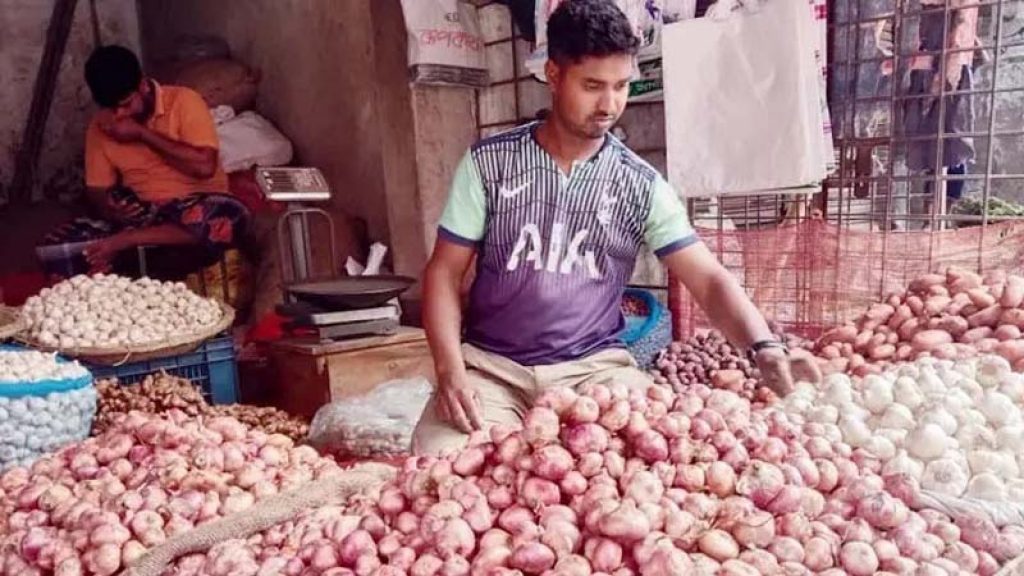

Farmers are facing losses this season like last season. They blame onion imports for this. Onion farmers believe that if there were no imports, the losses would have been covered by onions.
According to the Rajshahi Regional Agricultural Extension Office, 720,818 metric tons of onion have been produced in the Rajshahi region this season. It has been cultivated on 3,608 hectares of land. This amount of onion has never been cultivated in Rajshahi before.
Farmers said that currently, onions are being sold at 800 to 900 taka per maund in the wholesale market. And when they go to the market, these onions are being sold at 30 to 40 taka per kg. By cultivating onions on leased land, half of the costs are not covered. The cost of producing one maund of onions ranges from 1,500 to 1,800 taka.
Ahad Ali, a farmer from Durgapur, Rajshahi, said, “At the current price at which onions are being sold, we are facing losses of up to 20,000-30,000 taka per bigha. It is not possible to get the price before Eid. Still, it is not possible to say what will happen on Eid.”
Pobar farmer Shukur Mohammad said, “This time there has been a big loss in onions. Last time I had some profit from cultivation. But this time there will be a loss of 35 to 40 thousand taka. There is not much price in the market. I don’t know what to do.”
According to farmers, the cost of cultivating onion per bigha on their own land is 50,000 to 70,000 taka. On leased land, this cost increases to 70,000 to 90,000 taka, where the land rent alone is up to 35,000 taka per bigha.
Farmers are blaming previous onion imports for the fall in market prices. They allege that when domestic ‘murikata’ onions were entering the market at the beginning of the season, the local production did not get a fair price due to the entry of imported onions into the market.
Farmers fear that even though the crop has been harvested, many are not selling it due to the price. If everyone starts selling it together, the market price may fall further. Bagmara farmer Nur Mohammad said, “All the onions have been stored. I don’t have the courage to sell them because of the price. These onions will have to be sold before Eid al-Adha.”
Agriculture officials say that even though the country has reached close to self-sufficiency in onion production, ensuring fair prices for farmers is still a big challenge.
Obaidur Rahman Mandal, director of the field service branch of the Department of Agricultural Extension, said, “Although onions are eaten all year round, if everyone tries to sell them together, the market price drops. Therefore, it is not right to expect the production cost to recover immediately after harvesting.”
He said, “To increase the storage facilities, the government has already distributed about 8,000 airflow storage machines among farmers. Another 4,000 machines have been allocated. Through this, there will be an opportunity to store onions for a long time and sell them at a good price later. Losses after harvesting will also be reduced.”
Chairman Editorial Board : Md. Shajahan Mia
Chief Editor : Md. Humayoun Rashid, Editor : Ayub Ali Sarder
Publisher : Tahmina Akter Saima
Office : Motaleb Mansion (5th Floor), 2 R. K. Mission Road, Dhaka -1203 Phone : 01711681147,01710453070
Email : morningobserver@gmail.com
All rights reserved © 2025 dailymorningobserver