
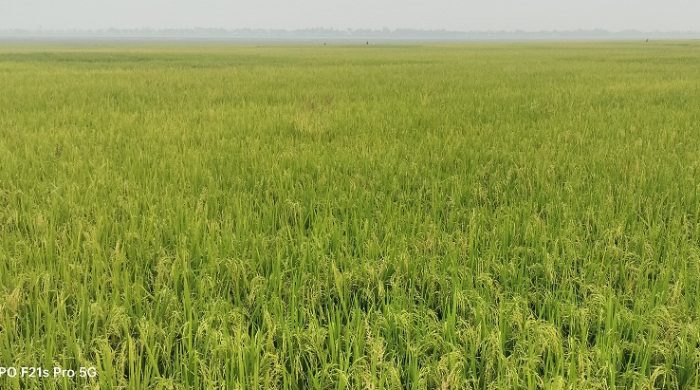
Faruk, a landless farmer of the Beel, said that he has planted Boro rice on 22 kathas of land at the very bottom of the Beel. The paddy has been good. It will take about 20 more days to harvest the lower land. From planting to harvesting, it will cost about 16/17 thousand taka.
The farmers, including drainman Shakir Munsur, in a deep tube well in Dhantayar Mouza under the Dakbungalow field, said that this time the disease is very low in the land of the bill. Fertilizers and pesticides are used less. Again, the weather was excellent. There was no adversity. Irrigation water was provided on time. There was no shortage of electricity. Vegetables including potatoes are cultivated in the land above the bill. Potatoes and vegetables are harvested and rice is planted. However, most of the land is cultivated in one crop. In the lower bigha, the yield of rice ranges from 25 to 28/30 maunds.
Shakir also said that Boro paddy has been cultivated on three and a half bighas of land. Paddy harvesting will start within a week. Another farmer named Bakul has cultivated 7 bighas of land of the bill by taking a tender. Monayem has cultivated three bighas, Halim two and a half bighas, Mannan eight bighas, Hakim has cultivated three bighas in tender, Saheb three bighas, a farmer named Shaon has cultivated 6 bighas, a farmer from Hindupara village has cultivated three bighas and another farmer named Adhir has cultivated 10 bighas of boro paddy. They said that the paddy in Beel’s land has ripened. There has been a heat wave for a few days. The sun has also set and the paddy is ripe. Paddy harvesting will start a week ago. The cost from planting to harvesting on Beel’s own one bigha of land will be 16/17 thousand taka. And on a bigha of leased land, the cost will be 22/24 thousand taka. If the paddy can be harvested well in the threshing floor, the profit on one’s own land can be 10/11 thousand taka. And on leased land, the profit can be 4/5 thousand taka per bigha. However, if the weather is unfavorable, dry straw will not be available. In that case, the profit will be less. And if the weather is favorable, the profit will be good. Because the price of straw is good.
Farmers say that the price of rice has decreased by 400 to 500 taka. Due to the war in the Middle East, the country is facing a huge oil crisis. Due to oil, cars are not coming. There is no buying and selling of rice. If this continues, we will have to sit on the road. Despite the increase in the price of all things, the price of rice and potatoes is still falling. Traders from outside are not able to come. Even if one or two people come, the car fare is double. If the government does not pay attention to the farmers, the produced crops are being cut off.
It is learned that advance boro cultivation has been carried out on the land of Bilkumari Beel from Chanduria Bridge Ghat in the upazila to Chaubaria Bridge in Kamargaon UP on the border. Especially Chanduria, Chakdamdama, Hardah, Gagrand, Kaliganj, Habib Nagar, Akcha, Buruj, Jiol, Chadpur, Amsho, Muthurapur, Sarkar Para, Tatial Para, Gollapara, Haldarpara, Tanor Para, Kuthipara, Hindupara, Gubirpara, Sindukai, Dhantayar, Chapra, Gokul, Talanda, Kamarga UP, Labiyatala Bridge west, east, north, south, Hatishail, Barogharia, Hatinanda, Chaiard, Kamarga, Kachua, Shrikhanda, Damdama, Krishnapur, Parisho, Durgapur, Bataspur, Maria, Madaripur, Jamshedpur Bhabanipur, Dhanoria, Chakkajizia, Malshira, Kalma UP, Kujishahar, Boro is being cultivated in the land of the Beel below Chandankatha village. Almost all the paddy in the land has ripened. Boro is cultivated in advance in the land of these areas. And after the potato harvest, another round of Boro paddy is being cultivated. The paddy plants in the potato land have turned black. Some are suppressing weeds, some are applying pesticides to eliminate diseases.
Municipality BS Akbar Ali said that the paddy in the Beel land has ripened. This time there was no disease in the paddy. As a result, the farmers’ expenses have also reduced. As soon as the news of the disease was received in one or two places, the farmers were immediately given proper advice. The weather has been favorable so far. I am sure that the farmers will benefit from the paddy in the Beel land.
Noor Mohammad, a farmer and agricultural scientist from Beelpar, said that the yield in the Beel land is good. This time the weather was favorable. There was no natural disaster. Many people will have to harvest their paddy a week in advance. The month of Baishakh has begun. There is a fear of the Boishakhi storm among the farmers of Beelpar tomorrow. Because the ancestors used to say that Boro rice is the only thing that will come and go. But just because of that, it is not okay to give up cultivation. We have to cultivate. However, he expressed disappointment due to the decrease in the price of rice. Because if the farmers do not get a fair price for their crops, they will lose interest in cultivation in the future. For this, arrangements must be made for a fair price for the crops.
Upazila Agriculture Officer Saifullah Ahmed said that the rice in the Beel land has started to ripen. And harvesting will start in two or four days. The farmers will get the desired yield. Because everything has been done correctly. One crop is planted in most of the land. Due to this, the farmers along the Beel get sufficient yield. And the field workers have worked in the field round the clock. The cost of fertilizers and pesticides has been reduced. This time, Boro rice has been cultivated on 14,130 hectares of land in the upazila.
Fishermen’s lament: There is no water in the Beel. The main part of the Beel is considered to be the main part of the Beel to the northeast of the Dakbungalow field. The main part is 2 hectares of Beel Sanctuary. It is surrounded by bamboo. There is no fish in the lake due to lack of water. Thousands of fishermen are living an extremely inhuman life.
Fishermen Rafiqul Islam Bisu, Afzal, Sabur, Azimul Azizur and many others said that no fish has been found in the lake for about a month and a half. They are running their families by taking loans. Our family and livelihood depend on the fish in the lake. We cannot do agricultural work. The fish in the lake are our everything. If there is no fish in the lake, we have to go through the day half-eaten and starving. We are dependent on NGO loans. Now, should we feed our family members or pay the installments of the NGO? Many have left the area due to the pressure of installments. At this time, it is absolutely necessary for the government to help the real fishermen.
Chairman Editorial Board : Md. Shajahan Mia
Chief Editor : Md. Humayoun Rashid, Editor : Ayub Ali Sarder
Publisher : Tahmina Akter Saima
Office : Motaleb Mansion (5th Floor), 2 R. K. Mission Road, Dhaka -1203 Phone : 01711681147,01710453070
Email : morningobserver@gmail.com
All rights reserved © 2025 dailymorningobserver