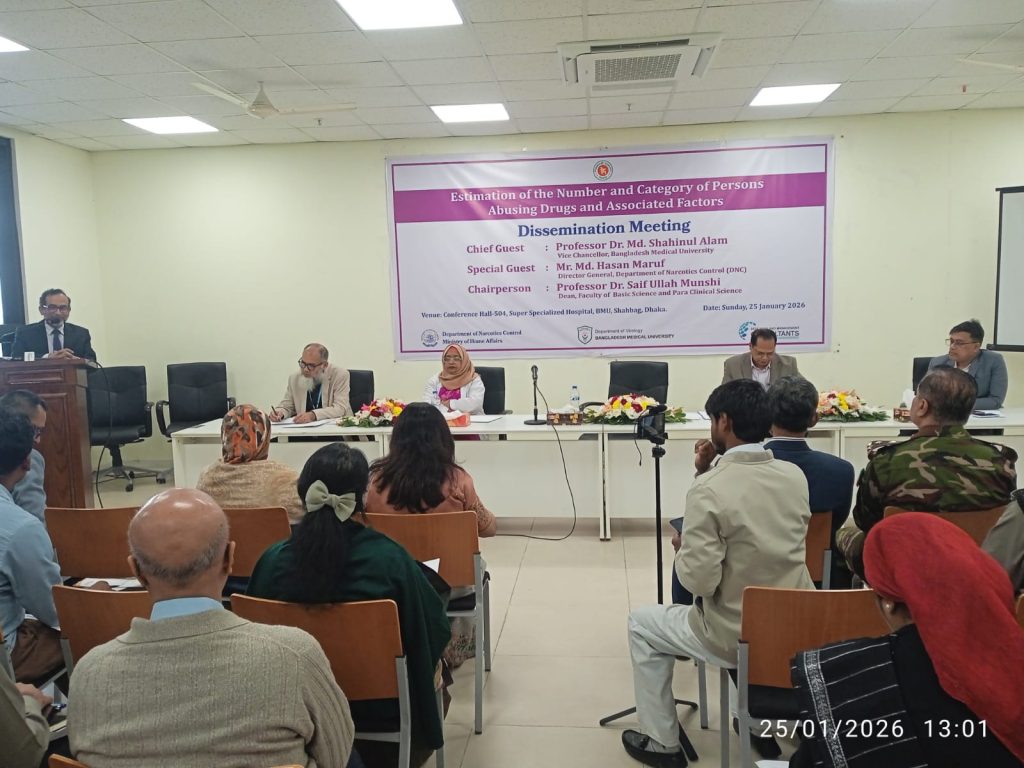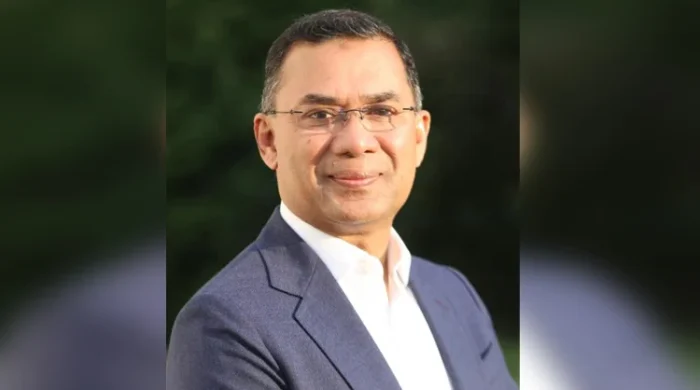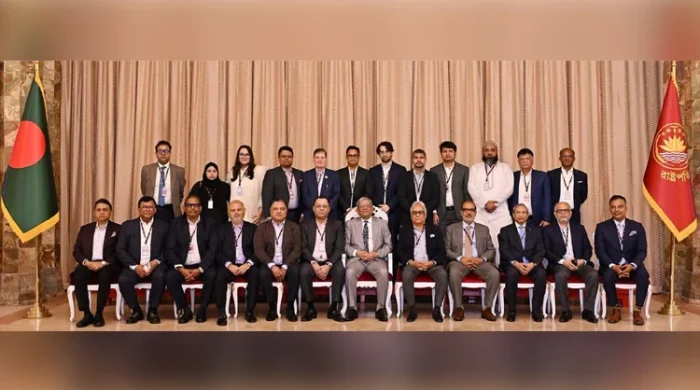

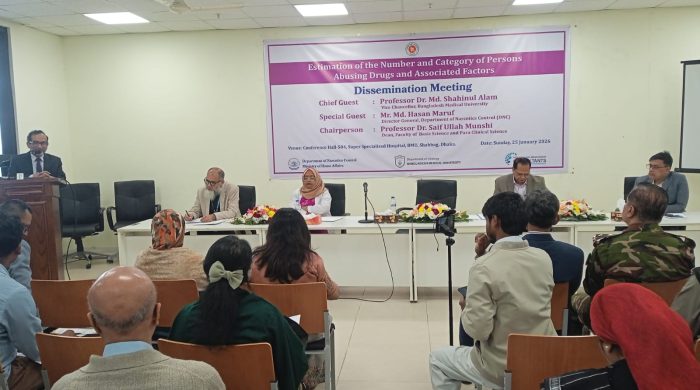
The results of a national-level study on the number, type and associated factors of drug abusers in Bangladesh have been published (Dissemination Meeting of Estimation of the Number and Category of Persons Abusing Drugs and Associated Factors. A Nationwide Study in Bangladesh). On Sunday, January 25, 2026, at the Conference Hall, Room 504 of the Super Specialized Hospital, the chief guest was the Vice-Chancellor of BMU, Professor Dr. Md. Shahinul Alam. The special guest was the Director General of the Narcotics Control Department, Mr. Md. Hasan Maruf. The Dean of BMU, Professor Dr. Saif Ullah Munshi, was present as the Principal Investigator. Vice-Chancellor of BMU, Professor Dr. Md. Shahinul Alam, in his speech, emphasized political commitment and more research in drug prevention and said, “There is no reason to think that a few bad people are addicted to drugs and that we or our children are away from drugs. In fact, we or our children are at risk of becoming addicted to drugs. Everyone must be aware and confront this risk in a united manner. Director General of the Narcotics Control Department, Mr. Md. Hasan Maruf said, “The current time and reality is that the people of the country are at risk of becoming addicted to drugs. We must continue to fight against drugs collectively through social movements and a social war. We must ensure that prevention begins in the family to eradicate drugs. In order to expand medical services for drug addicts, the current government has approved a project to launch 7 drug addiction treatment and rehabilitation centers with 200 beds in 7 more divisions except Dhaka. Treasurer of BMU, Professor Dr. Nahrin Akhtar, in her speech, emphasized on reducing the source of drug supply and demand and said, “Children and youth who are addicted to drugs before they can understand life, we must all work together to protect these children and young people from the terrible harm of drug use.
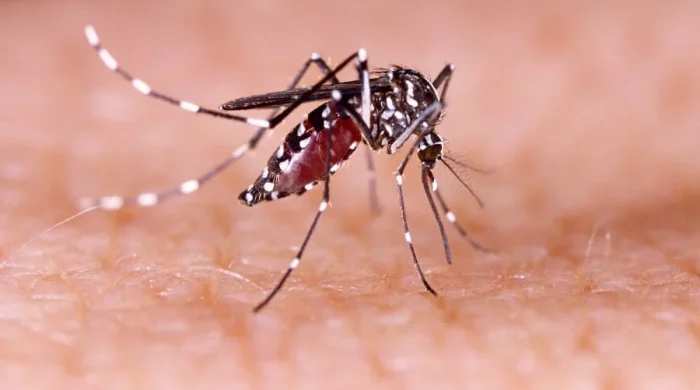
Drug use in Bangladesh has become a serious public health and social crisis. The results of the National Drug Use Survey organized by Bangladesh Medical University revealed that an estimated 8.2 million people in the country are currently using some form of illicit drugs, which is about 4.88 percent of the total population. This study did not include cigarette smoking as a drug use. The study was conducted under the supervision of the Department of Narcotics Control (DNC). Bangladesh Medical University (BMU) and Research and Management Consultants Limited (RMCL) jointly completed the research program between February and June 2025. The study collected data from 13 districts and 26 upazilas of eight divisions of the country using the Network Scale-Up Method (NSUM). The results of the study show that there are significant differences in the rate of drug use by division. The rate of drug use is highest in Mysore (6.02%), Rangpur (6.00%) and Chittagong (5.50%) divisions. On the other hand, relatively low rates were observed in Rajshahi (2.72%) and Khulna (4.08%) divisions. In terms of numbers, the highest number of drug users live in Dhaka division (about 2.29 lakh), followed by Chittagong (1.88 lakh) and Rangpur division (about 1.08 lakh). The estimated number of drug users by division is Barisal 4,04,118, Chittagong 1,879,503, Dhaka 2,87,970, Khulna 7,26,210, Mymensingh 7,60,812 people, Rajshahi 5,66,509 people, Rangpur 10,80,588 people and Sylhet 4,88,141 people. The entire country (users of any type of drug) is 8,194,651 people. An analysis of drug types shows that cannabis is the most commonly used drug in Bangladesh. About 6.1 million people use cannabis. This is followed by yaba or methamphetamine (about 2.3 million), alcohol (2 million), codeine-containing cough syrup, sleeping pills and heroin. The number of people who inject drugs is about 39,000, but people who inject drugs are at high risk of HIV, hepatitis and other infectious diseases. The study shows that a drug user spends about six thousand taka per month.
The estimated number of drug users by type of drug use is 6,079,914 for marijuana (cannabis), 2,292,705 for methamphetamine (yaba), 2,020,977 for alcohol, 339,660 for codeine phosphate (cough syrup), 322,677 for heroin, 305,694 for sleeping pills, 152,847 for inhalants (e.g. glue, paint thinner) and 39,061 for injection. In addition, 11,888 use crystal meth (ice), 5,095 for LSD (ecstasy) and 13,58,64 for other drugs.
Another thing is that a person can use more than one type of drug. The study also found that most drug users are young. About 33 percent of users first started using drugs between the ages of 8-17 or as children. 59 percent of users first started using drugs between the ages of 18-25.
Unemployment, peer pressure, financial uncertainty, family instability, mental stress, and involvement in informal occupations have been identified as major risk factors for drug use. Alarmingly, nearly 90 percent of users report that drugs are readily available.
Treatment and rehabilitation opportunities for drug users in Bangladesh are very limited. Research shows that only 13 percent of drug users have ever received treatment or rehabilitation services. Although more than half of users have tried to quit drugs, most have not been successful due to the lack of adequate drug dependence treatment, counseling, social and financial support. Drug users cited treatment and rehabilitation services (69%), counseling (62%), and employment support (41.2%) as their most urgent needs. 68% of drug users reported being victims of stigma and discrimination in social and family settings.
Experts believe that the results of this study clearly indicate that the drug problem is not just a law and order issue: it is a complex public health, social and economic problem. The need of the hour is to adopt an integrated public health approach that includes prevention, treatment, rehabilitation, mental health care, employment and social reintegration, rather than relying solely on repressive or punitive approaches. The stakeholders hope that this evidence-based evidence from the study will serve as an important basis for future national policy formulation, program planning and public-private joint initiatives.
Also present at the event were Additional Director General of the Narcotics Control Department, Mr. Mohammad Golam Azam, Co-Investigator Professor Dr. Md. Tajul Islam, Co-Investigator Forkan Hossain, BMU Director (Hospital) Brigadier General Irteka Rahman, Additional Director (Super Specialized Hospital) Dr. Md. Shahidul Hasan Babul, and others. Edited Dr. Saiful Azam Ranju.
Chairman Editorial Board : Md. Shajahan Mia
Chief Editor : Md. Humayoun Rashid, Editor : Ayub Ali Sarder
Publisher : Tahmina Akter Saima
Office : Motaleb Mansion (5th Floor), 2 R. K. Mission Road, Dhaka -1203 Phone : 01711681147,01710453070
Email : morningobserver@gmail.com
All rights reserved © 2025 dailymorningobserver