
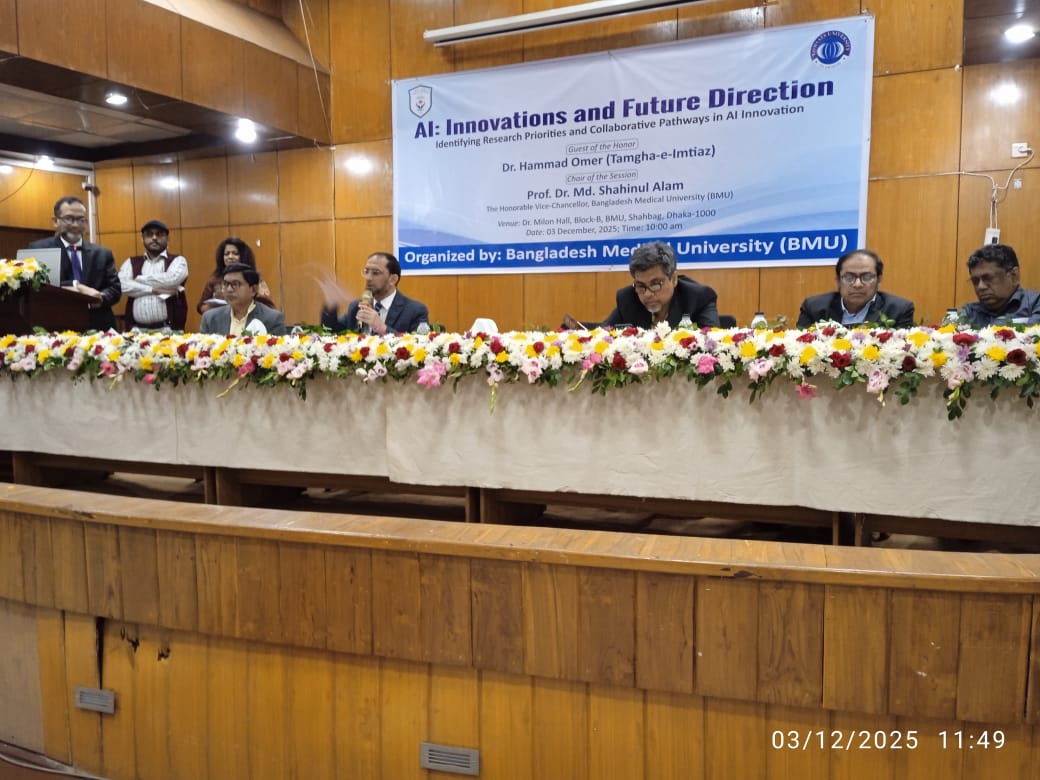
Wednesday, Dec 3: A seminar on ‘AI: Innovations and Future Direction’ was held at Bangladesh Medical University (BMU). The guest of honor and keynote speaker at this seminar organized by BMU was international expert Dr. Hammad Omer, Academic Administrator of COMSATS University Islamabad, Pakistan and recipient of Tamgha-e-Imtiaz Award. Tamgha-E-Imtiaz).
The seminar discussed in detail various topics including the role of AI in modern medical science, potential, progress, development, research priorities in AI innovation, identifying collaborative paths, future research areas, and outlines for the formation of technology-integrated healthcare.
The guest of honor of the event, Dr. Hammad Omar (Tamgha-e-Imtiaz), a very well-known AI researcher and technology development expert in the international arena, highlighted various aspects of the rapid advancement of AI in global medical research, biomedical data analysis, automated disease diagnosis technology, and public health management. He said that artificial intelligence is no longer the future; it is a powerful tool to elevate the current medical system to a new level. Research collaboration and policy coordination are essential to increase its application in Bangladesh. Incorporating AI-enabled technology in medical education, research, and patient care is the need of the hour. There is a huge opportunity to create human resources by developing and enhancing the skills of the existing manpower in Bangladesh Medical University, and to utilize AI technology through proper utilization of resources. He answered various questions from the esteemed faculty and residents participating in the event.
BMU’s Vice Chancellor Professor Dr. Md. Shahinul Alam said, AI can contribute to all aspects of the medical sector or health sector. It is desirable that BMU will lead the development of the healthcare sector in Bangladesh through the use of AI. BMU has a large number of patients, a lot of data. Through which there are many research opportunities. It is possible to take the lead in health research, medical services and higher medical education in Bangladesh by utilizing the resources of BMU. As the first medical university in the country, all concerned will have to work to fulfill that goal. Mutual cooperation between various domestic and foreign institutions and experts will facilitate reaching this goal. Today’s initiative is also part of that.
BMU’s Pro-Vice Chancellor (Administration) Professor Dr. Md. Abul Kalam Azad said, AI is a technology. It is important to acquire the necessary knowledge in this subject by undergoing training in AI. The importance of AI technology in various subjects including oncology and radiology is immense. AI can contribute to early diagnosis and rapid accurate diagnosis. Therefore, doctors must also have the necessary knowledge and skills in this regard.
Also speaking at the event were Dean of the Faculty of Medicine, Professor Dr. Md. Shamim Ahmed, Dean of the Faculty of Surgery, Professor Dr. Md. Ibrahim Siddique, Dean of the Faculty of Preventive and Social Medicine, Professor Dr. Md. Atiqul Haque, PhD.
Other speakers at the seminar said that there is an opportunity to enrich BMU with AII technology through mutual collaborative work with various universities and research institutions at home and abroad. Through AI technology, it is possible to identify complex diseases with speed and accuracy.
The seminar highlighted various topics including specialized training needed for domestic researchers, health data management and disease management, machine-learning platforms in medical research, robotic support, etc. They emphasized regional-international cooperation to harness the potential of AI.
The program was hosted by Dr. Farzana Islam and Dr. SM Shahidul Haque Rahat of the Department of Public Health Informatics. The program was attended by Professor Dr. Md. Abdul Mannan, Chairman of the Department of Neonatology, Assistant Professor Dr. Md. Russell Ahmed of the Department of Public Health Informatics, and other teachers and residents of the department. Edited by Dr. Saiful Azam Ranju.