
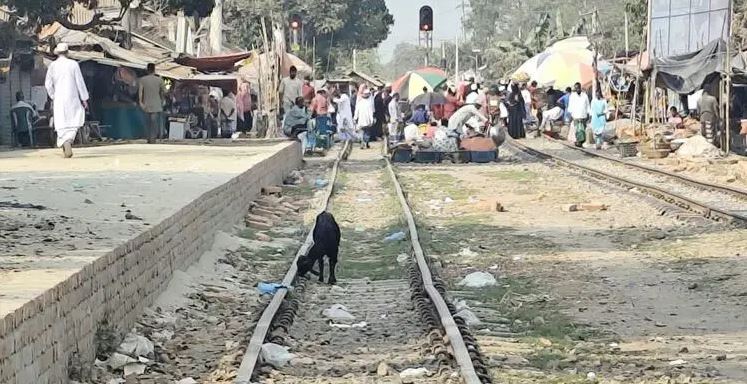
The Rajshahi-Abdulpur Junction section of the Rajshahi-Iswardi railway line, one of the most important in the northwestern part of the country, has become dilapidated and extremely fragile. Of this 45-kilometer single broad gauge line, 35 kilometers are currently extremely risky. To avoid accidents, the normal speed limit of trains on this route has been reduced from 95 kilometers to 40 kilometers. As a result, trains are running later than the scheduled time every day and a serious schedule disaster is being created.
Minor and major accidents are constantly occurring on this old British-era railway line, which has not been renovated for more than 50 years. Recently, extreme anxiety and suffering have arisen in the minds of thousands of passengers traveling ahead of the upcoming Eid.
Concerned passengers and locals complain that despite regular talks about new projects, the Western Railway has not taken any visible effective initiative to permanently repair or maintain this dilapidated line. Whenever the line breaks somewhere, arrangements are made to temporarily run trains by patching it up.
According to railway sources, several major tragedies have been averted in the last two-three years due to timely action by local residents and alert train drivers. In 2025, a two-foot section of the railway track broke near Sardah Road station after the Panchagarh-bound ‘Banglabandha Express’ left.
Later, local villagers stopped the ‘Sagardari Express’ coming from Khulna by showing red cloths and lights, saving the lives of about 700 passengers. Similarly, farmers waving red flags after seeing broken lines at Lokmanpur, Sardah, Arani Rail Bridge and other places, and the activities of temporary gatekeepers saved thousands of passengers on trains like ‘Banalata Express’, ‘Barendra Express’ and ‘Commuter Express’ from major accidents.
It has been seen on the ground that the condition of the wood and clips of the 35-kilometer section from Arani to Rajshahi via Sardah Road and Nandan Gachhi is very dilapidated. Many wooden sleepers have been damaged by the sun and rain, and there is an acute shortage of sufficient stones on the line. The last major renovation work on this line was in 1962. Although a project to double the line on this route was taken in the 2000s, no real progress has been made in two decades; the project is still stuck at the feasibility study stage.
Pakshi Divisional Transport Officer (DTO) Hasina Khatun said that 13 pairs of intercity, 4 pairs of mail and 3 pairs of local trains currently run on this route every day, except for one break a week. Urgent renovation is necessary to ensure safe travel on this long-standing line.
Pakshi Divisional Engineer-2 Najib Kaiser and Assistant Engineer (AEN) Babul Hossain said that the construction of a new line is now the need of the hour as the life span has crossed 50 years. However, for now, train movement is being maintained normal through temporary repairs, keeping railway workers on maximum alert. Pakshi Divisional Railway Manager (DRM) Abu Hena Mustafa said that emphasis is being placed on ensuring uninterrupted service and safety of passengers ahead of Eid and the renovation work will start soon.
Strong demand for dual gauge and double lines:
Considering the seriousness of the situation, the demand for the rapid upgrade of the Rajshahi-Abdulpur railway to dual gauge and the implementation of double lines is now high across the northern region. A huge amount of perishable agricultural products including mangoes, paddy, potatoes, tomatoes, cauliflower and other perishables are transported from the Rajshahi region to the rest of the country every day. But due to the slow speed of the railway and schedule disruptions, farmers and local traders are facing extreme losses as the products are not able to reach them on time.
According to experts and concerned people, if a dual gauge double line is introduced on this route along with the addition of refrigerated and modern freight wagons, it will be possible to reach agricultural products across the country quickly. In this, farmers will get fair prices, and a large market for food processing factories, cold storage and logistics sectors will be created around Rajshahi. If a fast and modern communication system is introduced, the Rajshahi region will become a major regional commercial hub, which will bring revolutionary changes to the economic landscape of the northern region.