
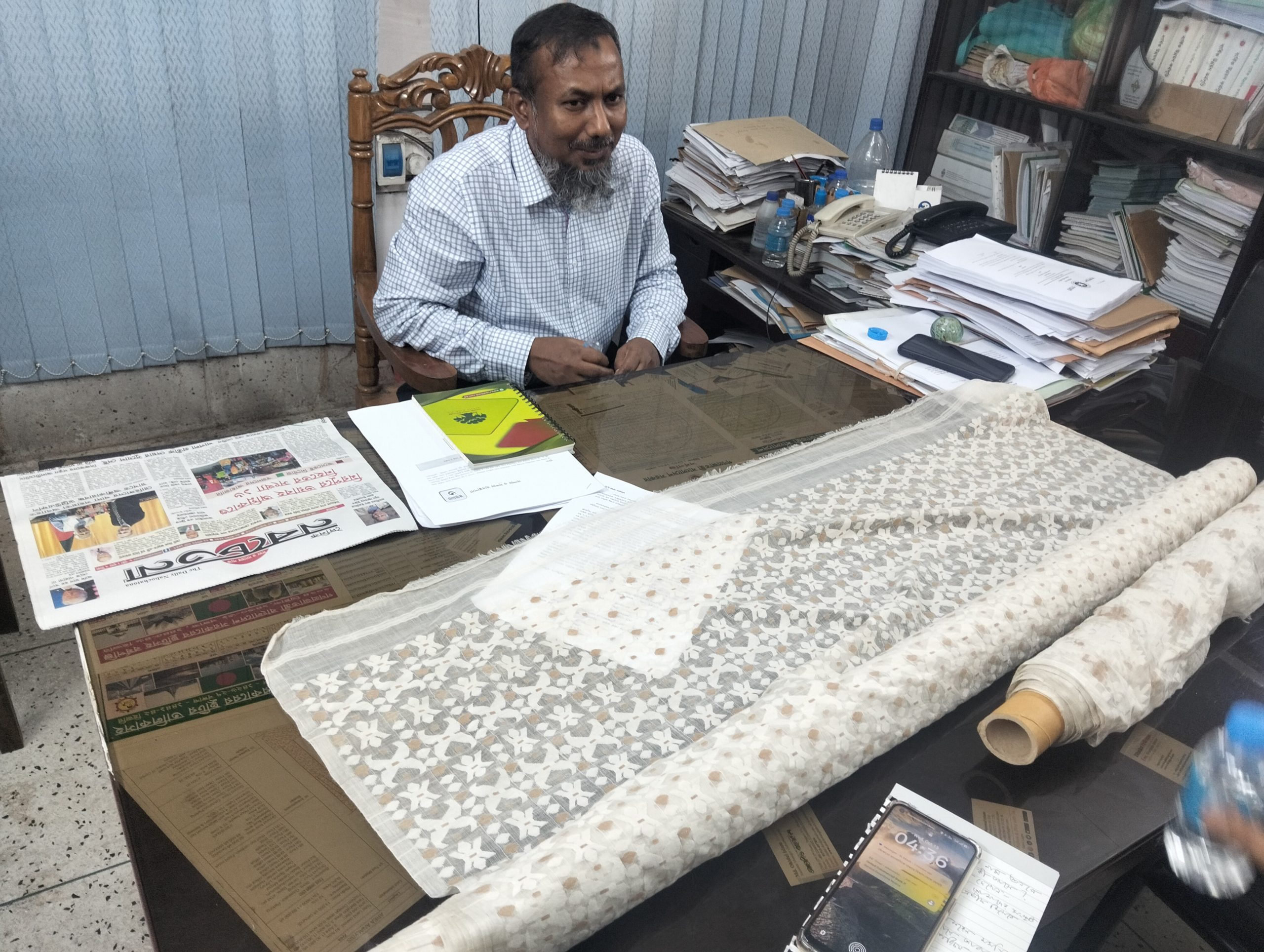
Dhakai Muslin is one of the most famous and traditional fine fabrics in the world. It was originally produced in and around Dhaka, the capital of Bangladesh. Muslin has a history that dates back thousands of years, and was famous in Greece, Rome, Egypt, Arabia, and Europe.
There are various theories about the origin of the word muslin. Some say it comes from Mosul (a city in Iraq), while others believe it comes from the word Mausuli or Moslin, which was used by European merchants.
However, “Dhaka Muslin” refers to the fine, light, and luxurious fabric that was originally made in the Sonargaon, Titabari, Joydevpur, Narayanganj, and Dhamrai areas along the banks of the Buriganga River.
A special type of cotton—”Phuti Karpas”—was used to make Dhaka muslin.
The fibers of this cotton were extremely fine, soft and lustrous. The threads of muslin were so thin that there were hundreds of threads in an inch of cloth. A muslin saree was so large that an entire saree could be passed through a ring.
Dhakai muslin reached its peak during the Mughal period (16th-18th centuries). Mughal emperors used it as royal clothing.
“Jamdani” and “Malmal” were its famous types.
Foreign merchants (especially the English, Dutch, Portuguese, and French) exported it to Europe.
European women wore muslin dresses at royal courts and aristocratic events.
When the British took power in the Indian subcontinent in the late 18th century, they began to destroy the Dhaka muslin industry in order to sell their own machine-made cloth. Weavers were taxed and tortured.
It is also common to hear of many weavers having their hands cut off (although there is historical debate about this).
As a result, the muslin industry quickly disappeared. Recently, initiatives have been taken to revive Dhakai muslin in Bangladesh.
The Bangladesh Handloom Board and some researchers have rediscovered “footy cotton”.
A new generation of weavers is working to bring back the tradition.
When asked about this, Md. Ayub Ali, Head of Planning and Implementation of Bangladesh Weaving Board, said, “By Dhakai Muslin, we mean Bangladeshi muslin. In 1747, Dhakai muslin worth about 28 lakh 50 thousand taka was exported abroad. This is our great heritage. Our heritage will be brought back. Its economic value is very high. It will be added to the list of our export products and many people will be employed here. It can be seen that at a time when many people were backward in human and social aspects all over the world, Bangladesh’s heritage was very rich. When we look at our muslin and jamdani, the works and motifs of our history, tradition and culture are carried by our muslin and jamdani. To bring back this heritage, our Dhakai muslin has been established through the combined efforts of not only the Bangladesh Weaving Board, but also the Bangladesh Government, Bangladesh Weaving Board, Bangladesh Textile University, Rajshahi University and Narayanganj Comilla weavers.”
Today, “Dhaka Jamdani” is recognized as a World Heritage Site by UNESCO. Its origin Dhaka and surrounding areas.
Key ingredients Footy cotton. Fame Subtlety, lightness, royal quality, As a result of global recognition since the early 21st century, Recognized as a heritage by UNESCO.