
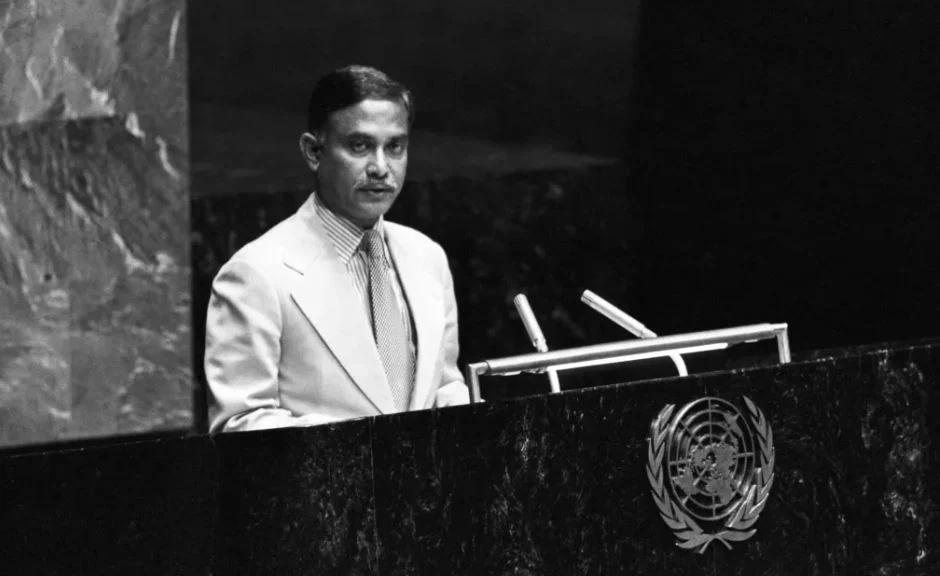
Proclaimer of Independence Shaheed President Ziaur Rahman, in his address to the United Nations General Assembly’s in 1980, presented Bangladesh’s struggle for self-reliant development alongside a broader call for South Asian cooperation, regional peace and stability.
In his speech, Ziaur Rahman highlighted Bangladesh’s severe development challenges, including population pressure, unemployment, landlessness and low per capita income, while outlining the country’s efforts to achieve greater self-reliance through agricultural and rural development.
He said Bangladesh accounted for one-third of the population of the world’s least developed countries and was twice as densely populated as Japan and the Netherlands. More than half of the country’s population, he said, was either unemployed or consisted of landless peasants employed only seasonally, while around two million additional people had to be fed every year.
Despite the daunting challenges, he said, Bangladesh was determined to move forward. “Yet, we have not perished and we shall not perish,” said Ziaur Rahman.
He outlined Bangladesh’s plan to double food production in about five years, reduce the birth rate from 2.5 percent to 2 percent by 1985, expand schools and hospitals and ensure that “no man, woman or child will go without food, shelter or clothing.”
“Our priority is agricultural and rural development,” he said, stressing the need to galvanize the country’s nearly 90 million people into action.
“Our commitment to the democratic process will not be shaken,” he said, identifying “self-reliance” as the country’s motto. “We must succeed because we cannot afford to fail,” he added.
A significant part of his address was devoted to South Asian regional cooperation. Linking regional peace with national development and internal stability, Ziaur Rahman expressed concern over the impact of foreign military intervention in the region.
“The deterioration of the international situation due to foreign military intervention in the region, far and near, is totally incompatible with the objectives of the New International Economic Order,” he said.
He recalled that Bangladesh had recently proposed a South Asian summit conference, observing that while regional cooperation had developed in other parts of the world, there had been no serious efforts to promote cooperation among South Asian countries on a regional basis.
“Our first objective will be to get together and explore the possible areas of co-operation for the mutual benefit of all the countries of the region,” he said.
He pointed to the experience of other regions, saying regional cooperation had helped reduce tensions and soften the positions of adversaries in their common interest. “It is time we made a start in South Asia,” he said.
Ziaur Rahman also devoted considerable attention to the widening economic disparity between the developed North and developing South. He argued that lasting peace could not be secured while large sections of the world remained trapped in poverty and deprivation.
“Just as there can be no fragmentation of peace, there can be no fragmentation of the world into segments of rich and poor, without a serious threat to peace,” he said.
He supported the Brandt Commission’s recommendations and called for a New International Economic Order based on increased development assistance, greater transfer of resources and technology, fairer trade and stronger support for the least developed countries.
He also called for developed countries to double aid to the least developed countries and provide it as untied grants, while proposing concessional oil supplies and international efforts to develop the energy resources of the least developed countries.
For Bangladesh, he said, rising oil prices had placed a heavy burden on its foreign exchange resources and urged oil-producing countries to assume greater responsibility for supporting the least developed countries.
Concluding his address, Ziaur Rahman urged the international community to take bold and coordinated action, saying that the world had the resources and technology needed to improve the lives of its people.
“I sincerely hope and pray that we make the right choice at the right time,” he said.
The speech assumes added significance as Prime Minister Tarique Rahman is set to become the third member of his family to address the United Nations General Assembly during his maiden speech at the 81st session in New York on September 24.
He is expected to highlight Bangladesh’s renewed democratic journey, global peace and security, climate change, sustainable development and the Rohingya issue.
His father, Shaheed President Ziaur Rahman, was the first member of the family to address the UN General Assembly, on August 26, 1980, followed by his mother, former Prime Minister Begum Khaleda Zia, who addressed the Assembly on October 1, 1993.
Tarique Rahman’s forthcoming address will thus mark another chapter in the family’s association with the UN General Assembly, spanning more than four decades, as he presents Bangladesh’s national priorities and perspectives on regional and global issues before the world body.