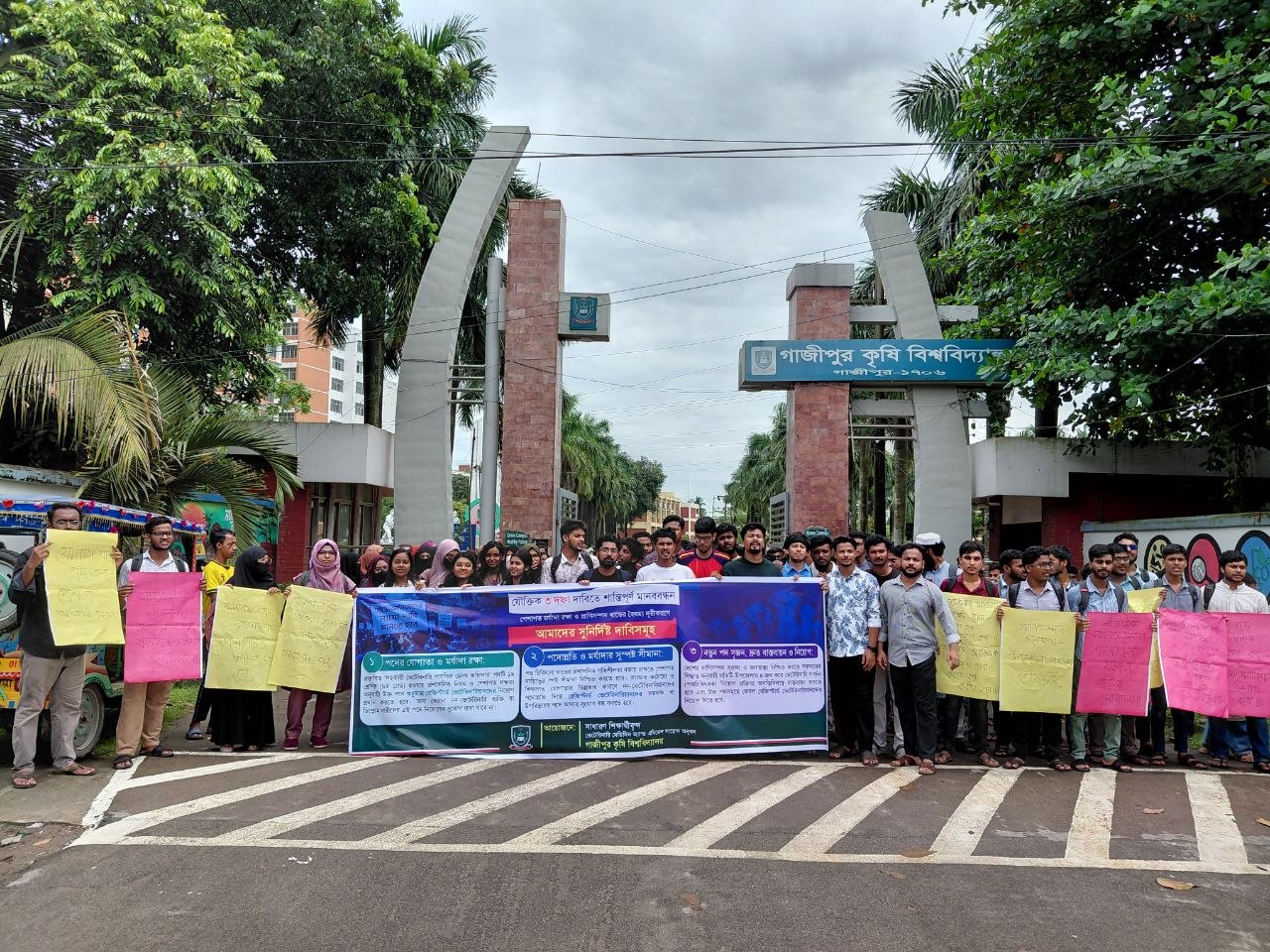
Students of the Faculty of Veterinary Medicine at Gazipur Agricultural University (GAU) formed a peaceful human chain on Sunday, demanding structural reforms in the veterinary profession, stronger field-level services and protection of the professional rights and identity of registered veterinarians. The program began at 11 am at the Faculty of Veterinary Medicine and Animal Science (FVMAS) the university’s administrative building and the main gate. General students joined the program, while teachers of the faculty expressed solidarity with the demands. The students said veterinary professionals play a vital role in ensuring the country’s animal-protein supply through research, clinical services and scientific planning. However, field-level veterinary services have not expanded in line with the growth of the livestock sector, universities and the number of veterinary graduates, they said. They noted that the post of Thana Assistant Veterinary Surgeon (TAVS) was introduced in the 1960s to provide veterinary services at the upazila level and was later incorporated into the cadre structure as Veterinary Surgeon (VS), Grade 9, during 1983-84. “Nearly six decades have passed, yet even in 2026, generally only one Veterinary Surgeon is responsible for veterinary treatment and services across an entire upazila,” the students said. The demonstration followed a recent government initiative to create 492 posts of Assistant Veterinary Public Health Officer under upazila livestock offices and veterinary hospitals. The approved proposal envisages creating 246 posts in 2026-27 and another 246 in 2027-28. While welcoming stronger veterinary public health services, the students raised concerns over the proposed posts’ grade, recruitment criteria and professional jurisdiction. They placed three demands: upgrading the post to Grade 9 with cligibility limited to registered veterinarians; preventing promotion of non-veterinary personnel to positions equivalent to or above registered veterinarians; and creating four Veterinary Surgeon posts in every upazila with immediate recruitment of registered veterinarians. The program ended with the students urging the authorities to undertake veterinary service reforms based on professional competence, scientific requirements and the country’s growing livestock needs.
রবিবার, ২০ সেপ্টেম্বর ২০২৬