
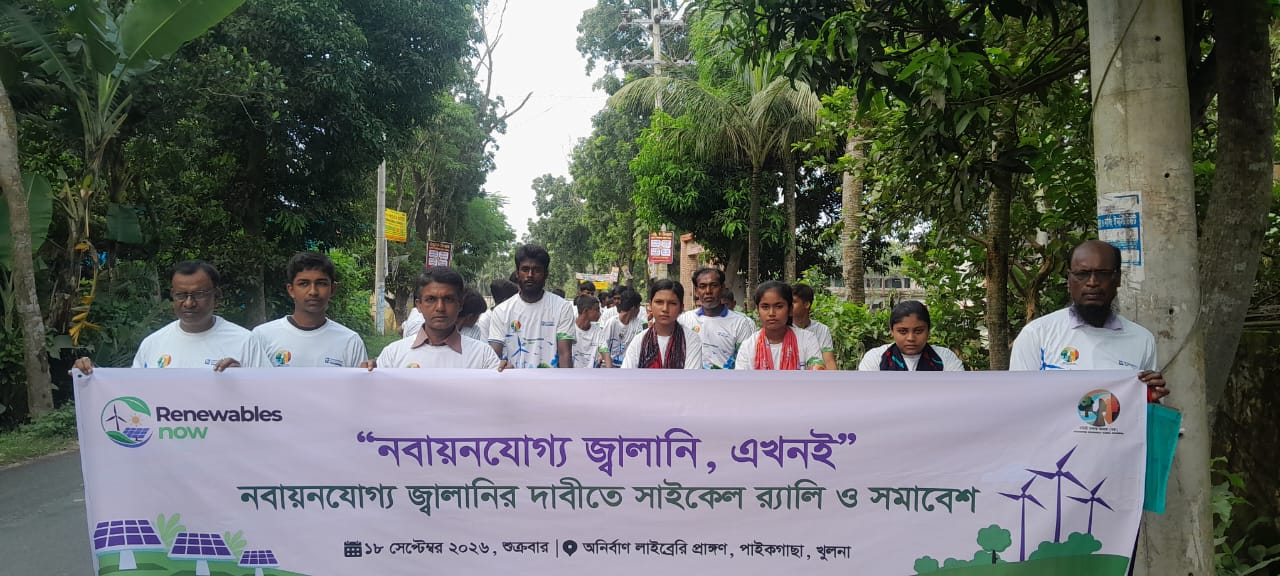
Forty-two civic and social organizations, including environmental and climate citizen organizations Dharitree Rakhaye Amara (Dhara), Waterkeepers Bangladesh, and Sundarbans and Coastal Protection Movement, have demanded the formulation of a specific action plan for renewable energy for the coast. The demand was made at a bicycle rally and gathering organized in Paikgachha of Khulna district and Tala upazila of Satkhira district on Friday, September 18.
As part of the month-long campaign titled ‘Renewable Energy, Now’ aimed at ensuring energy security, reducing import dependency and building a clean and equitable energy future, a rally was held at the Anirban Library premises in Mahmud Kati, Paigachha. Before the rally, a bicycle rally started from the Haridhali Secondary School grounds and circled various areas of Kapilmuni, Kashimnagar and Tala upazilas of Paigachha upazila in Satkhira district. During this, campaigns were held on renewable energy, addressing climate change risks and protecting the environment.
Sachetan Sangstha President Bidyut Biswas presided over the rally, and Sundarbans and Coastal Protection Movement Coordinator Nikhil Chandra Bhadra spoke virtually. Anirban Library Vice Presidents Basudeb Roy and Manik Bhadra, retired teacher Samiran Dey, development activist SM Afzal Hossain, environmental activist Shahidul Islam, and others also spoke at the rally.
Speakers at the gathering said that the biggest obstacle to renewable energy in Bangladesh is not technology, but the mindset of change. In our conventional understanding of power plants, thermal power plants still come to mind. This mindset needs to change. At the same time, ensuring quality batteries and solar panels is a big challenge in terms of profitability in renewable energy. He also said that there is still plenty of land in the country for installing solar. It is possible to produce solar power on a large scale by utilizing existing land like Matarbari. Now it is necessary to break the barriers of change and move towards solar power quickly. At the moment, there is no alternative to renewable energy. However, no decision can be taken hastily because there is no alternative. There is vast potential along the coast. Effective steps must be taken to utilize that potential.
The speakers said that fossil fuels are heating the atmosphere and increasing air pollution. Due to pollution, dust accumulates on solar panels, reducing their efficiency. As a result, reducing pollution will increase the efficiency of solar panels and the production of renewable energy. Renewable energy is no longer just a matter of protecting the environment; it is a question of the country’s energy security, economic self-reliance and sovereignty. We must produce our own energy to get out of the risk of an import-dependent energy system. A clear roadmap, effective steps and strong political commitment are needed now to achieve the goal of renewable electricity production. This change is not possible for the government alone, it is everyone’s responsibility. Out of that sense of responsibility and commitment, 42 organizations have jointly planned a special campaign titled ‘Renewable Energy, Now’.
The month-long campaign will include awareness programs, bicycle and boat rallies, road parades, coastal walks, cultural performances, seminars and national dialogues in various parts of the country to promote renewable energy, increase public awareness and create greater public involvement to achieve the 2030 target. The formal launch of the coastal walk will also begin as part of the campaign.