
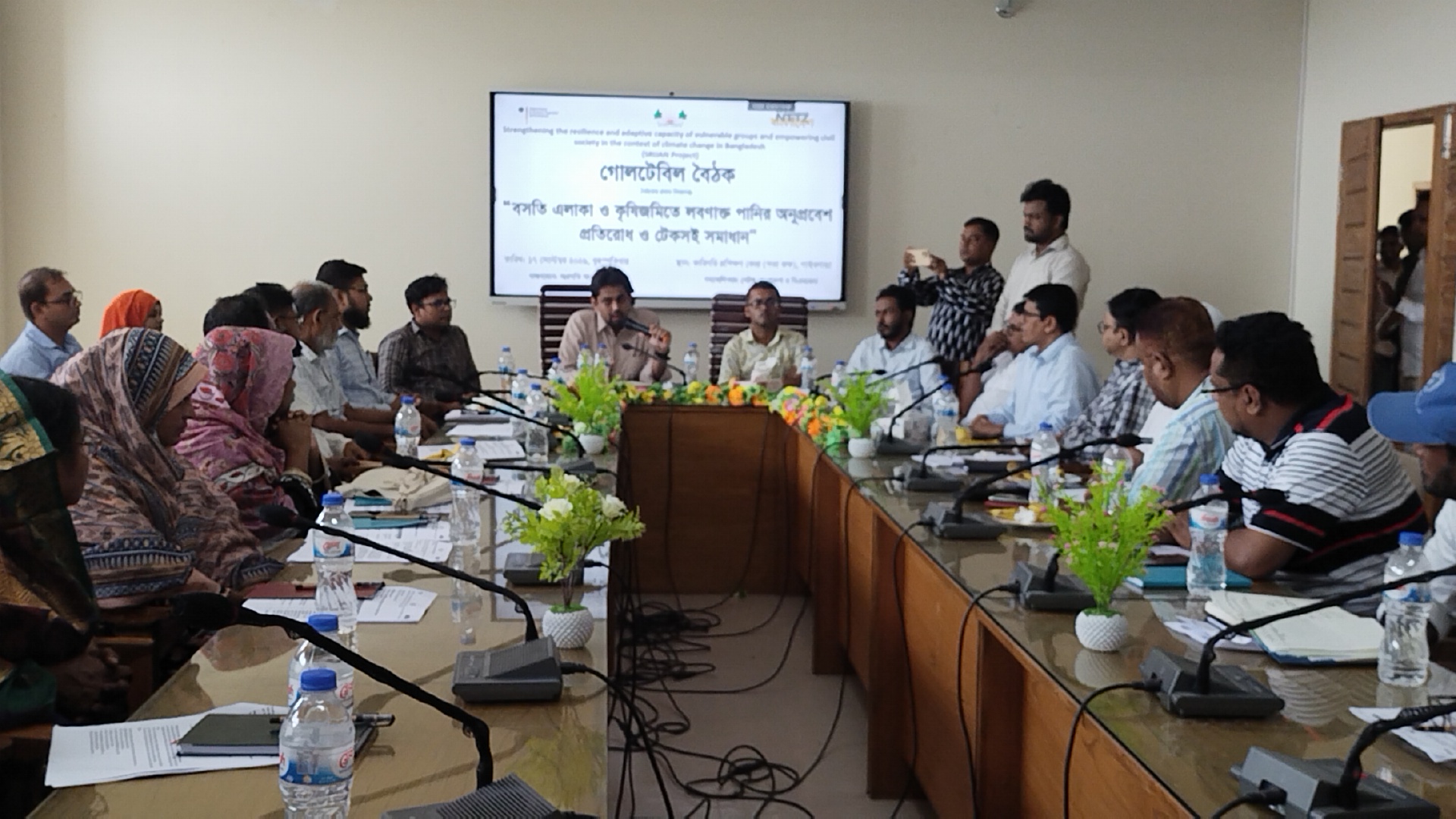
A roundtable meeting was held in Paikgachha, Khulna, on preventing saltwater intrusion into residential areas and agricultural lands due to the impact of climate change and its sustainable solutions.
The meeting was held under the Srijan Project at the meeting room of Paikgachha Technical Training Center on Thursday (September 17) at 11 am. The main topic of the meeting was – prevention of salt water intrusion in residential areas and agricultural lands and sustainable solutions.
The meeting, chaired by Upazila Executive Officer Wasiuzzaman Chowdhury, was attended by Senior Upazila Fisheries Officer Saikat Mallick, Livestock Officer Dr. Partha Pratim Roy, Koyra Upazila Women’s Affairs Officer Reshma Akhter, Assistant Agriculture Officer SM Monirul Islam, former General Secretary of Satkhira Press Club Mostafizur Rahman Ujjal, President of Paikgachha Press Club Advocate FM Razzak, former General Secretary SM Alauddin Sohag, Snehendu Bikash, General Secretary of Press Club Paikgachha M Jalal Uddin, Netz Bangladesh representatives Aminul Islam and Zakir Hossain.
The program was hosted by Abdus Sabur Biswas, Executive Director of Agraha Sangstha, Satkhira, and Riaz Ahmed, Project Manager of Srijan Project of Agraha Sangstha, Paikgachha.
SM Shahabuddin of the Koyra Water Committee, Lecturer Shah Newaz Shikari, Chairman of Maheshwarpur Union, Acting Chairman of Sonadana Union, Piyush Kanti Mandal, and representative of the affected civil society, Manjura Begum, spoke at the meeting.
The meeting discussed the impact of increasing salinity in coastal areas due to climate change, protection of settlements and agricultural land, effective initiatives to prevent saltwater intrusion, and various aspects of long-term sustainable solutions.
At this time, emphasis was placed on increasing the resilience and adaptive capacity of climate-vulnerable populations, strengthening the participation of local civil society, and working collaboratively with relevant stakeholders, including government and private institutions.
The meeting was attended by local public representatives, representatives of government and non-government organizations and NGOs, members of civil society, journalists, and stakeholders from various levels.