

Nazifa Jannat, a student of the English Department at East West
University and Vice President of the Bangladesh Student Union, emerged as one of the central
coordinators of the anti-discrimination student movement during the July Students-People’s Uprising.
She played a pivotal role in organizing protests in Rampura and her university campus East West
University, and thus became a key figure in mobilizing students across private institutions.
Coming from a politically active family, Nazifa’s interest and commitment to politics have been shaped
since childhood. The stories of the Liberation War and her family’s political history profoundly
influenced her thinking. This political consciousness inspired her to join leftist student organizations,
where she helped spark a new awareness among students of private universities.
Nazifa’s struggle has been tough—she has spent time in prison for her political activities and suffered
violence and oppression. She has faced countless challenges standing against state-backed
exploitation and anti-transformational forces. Yet, her resilient return and steadfast leadership have
grown the movement in strength and scale.
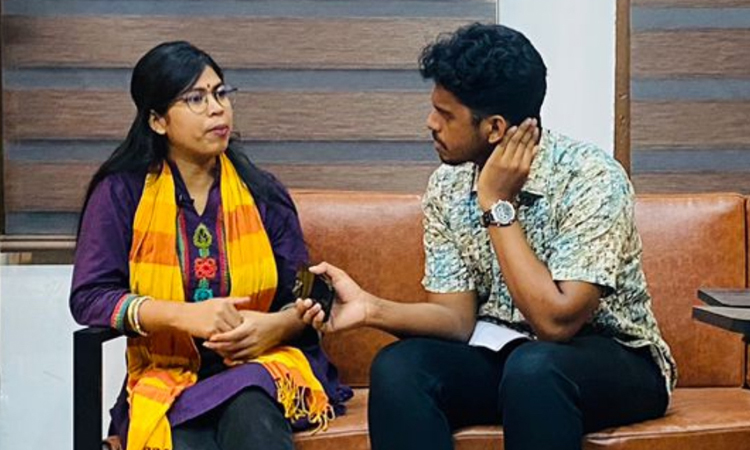
In this interview with Bangladesh Sangbad Sangstha (BSS), Nazifa Jannat shares her political journey,
experiences of persecution, and the story of organizing and leading the movement. Here is the
interview
BSS: How did your political journey begin? What made you enter politics?
Nazifa Jannat: Both my parents are teachers, so there were many books at home since I was young. I
grew up in a small town but received political insight from my father. The bloodied images of the
August 21 grenade attack and the killing of Bishwajit deeply shook me.
While still in school, I started reading — Samresh Majumdar’s book ‘Garbadharini’, and books on the
Liberation War, my father’s political thoughts — all of these together built the foundation of my
awareness. My maternal grandfather and uncle were freedom fighters, and my father and uncle also
helped during the liberation war. So, I developed an interest in the country’s politics and formation
process.
In college, I got involved in voluntary works, and then at university, I came into contact with some
people who encouraged me to be politically active. That’s when I learned about the 2018 quota reform
movement. I got enrolled in university in 2017. I felt that doing something alone wouldn’t work—I
needed a platform that matched my beliefs. I said I wouldn’t engage in terrorism or violent politics. A
senior then told me I could join a leftist organization. Since I had already read leftist texts, I joined
Chhatra Union. That’s how I came into politics.
Do you recall the suppression of dissent during the nearly 16 years of the Awami League’s rule?
You were always active in the field—have you ever been persecuted?