
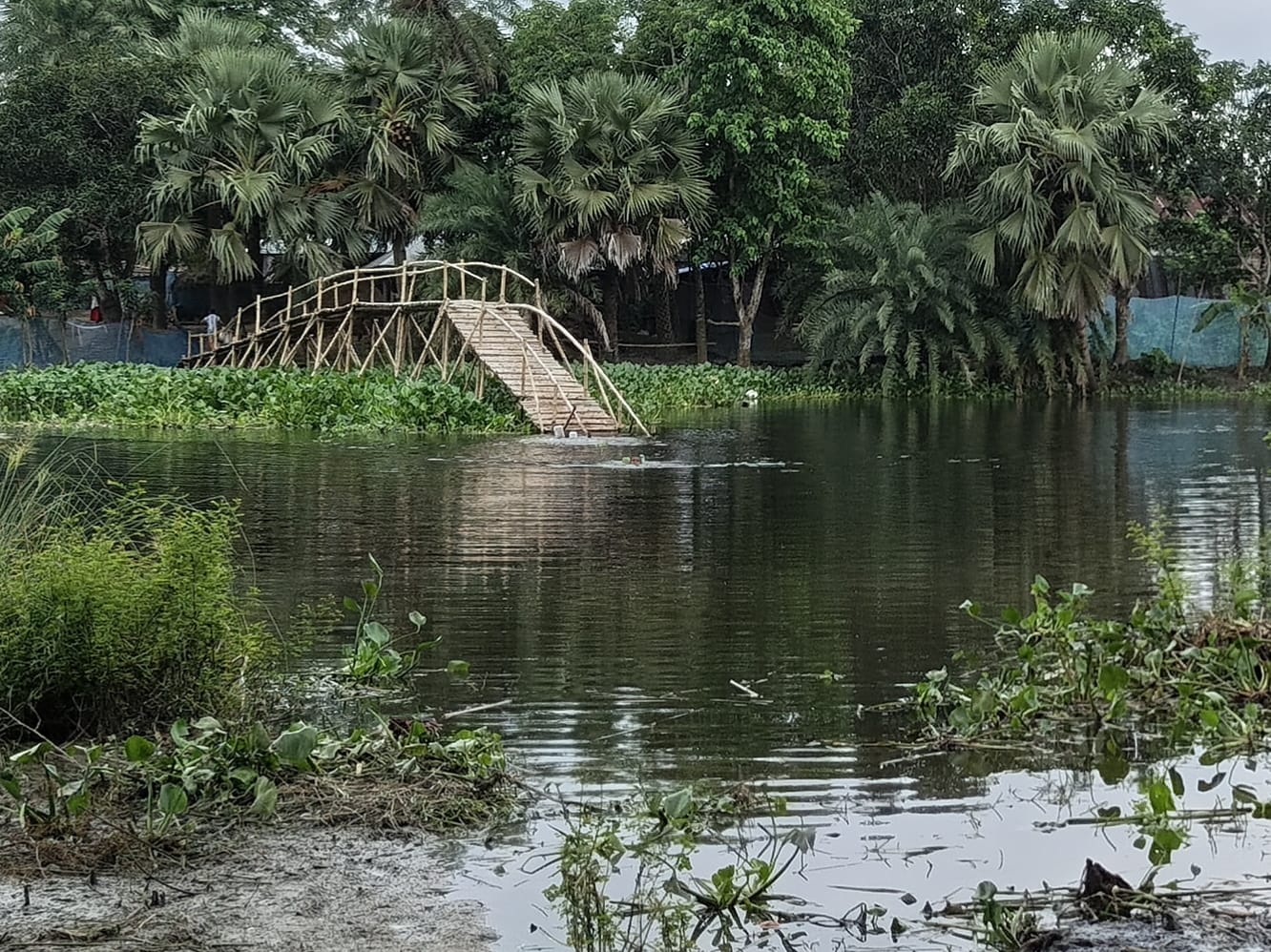
The distance from home to school is a few hundred yards. However, to cross that path, the young children have to cross a river that is about 32 feet deep. They have to cross the river in a small dinghy. When the water and current increase during the monsoon, the boat trip becomes dangerous. In the meantime, the only boat for crossing has also broken down. As a result, 70 to 80 students on the other side of the river have not been able to go to school regularly for about five months.
However, some are trying to cross the river by making rafts of banana trees, while others are risking their lives to swim to school.
Naogaon Government Primary School is located on the banks of the Kompo River in Kesharhat Municipality of Mohanpur Upazila of Rajshahi. On one side of the river is the school, and on the other side are the settlements of Malidaha and Gopail villages. There is a deep river in the middle. Due to the lack of a safe bridge, this river has been the biggest obstacle to the movement of students and locals for years.
Talking to locals, it was learned that the Naogaon Government Primary School was established in 1905. Although the school has been spreading the light of education for about 121 years, no permanent bridge has been built over the river for the safe transportation of its students. As a result, even though the school has grown in age, the risk of crossing the river has not decreased.
There is currently no safe way to cross the river. Without boats, people on both sides of the river have to travel about four kilometers to get there. During the rainy season, even that path becomes impassable due to mud. Therefore, students, farmers, patients and everyone in the locality are forced to cross the river in small boats.
Locals said that the depth of the Compo River is about 32 feet. Although it is possible to cross by boat during normal times, the risk increases several times during the monsoon when the water and current increase. There is a risk of accidents, especially for young primary school children, when they get on and off the boat. Parents have to live in fear as they cross the river every day carrying books, notebooks and school bags.
To temporarily reduce the problem, a bamboo bridge was built over the river with the ADP funding at the initiative of the Upazila LGED. But as the river water rose during the monsoon, a part of the bridge was submerged in the water. Since the remaining part is missing, the entire bridge is now impassable. As a result, boats were the only hope. The situation has become even more dire since that boat also broke down a few months ago.
Parents of Malidah village said that 70 to 80 students from the village have not been able to go to school regularly for about five months since the boat broke down. Their studies are being disrupted due to long absences from school. Many parents do not want to take the risk of sending their children to school across the river.
Acia Khatun, a guardian of Malidah village, said, “My children are very interested in studying. But there is no safe way to go to school. They have faced danger several times while crossing the river. Some even try to swim to the other side. They have not been able to go to school properly for about five months. We are very worried about the future of our children.”
Locals claim that once there were about 300 students studying in Naogaon Government Primary School. Currently, that number has reduced to half. Due to the long-standing communication crisis, many parents across the river have lost interest in enrolling their children in this school. As a result, the number of students in the school has almost come down to half.
Tanvir, a student at the school, said, “When the water and current in the river increase, it becomes scary to cross in a boat. Many times, I lose my balance while getting into the boat. Books and notebooks fall into the water. Now the boat has also broken down. That’s why going to school is almost stopped.”
Nasima Begum, acting headmistress of Naogaon Government Primary School, said, “Our school has about 150 students. Most of them are from Malidaha village. The rising water level poses a risk to students going to and from school. The Kompo River is very deep. Teachers regularly guide students and we are always ready to cooperate in bringing them to and from school safely.”
Talking to locals, it was also learned that not only students, but thousands of people on both sides of the river are suffering from this communication crisis. Farmers have to spend extra time and money to take their produce to the market. It also becomes difficult to take patients to the hospital in case of emergency. The situation becomes even more dire during the monsoon.
However, there is some hope for a permanent solution. A proposal to build a bridge over the Kompo River to connect Malidah and Naogaon villages in Kesharhat Municipality was sent from the upazila. The upazila engineering office said the proposal was approved in September 2025. However, it may take another two to three years for the bridge construction to begin.
Mohanpur Upazila Engineer said, ‘Considering the convenience of the locals, a bamboo bridge was built over the river through the Upazila LGED with the funding of ADP for the temporary movement of students. But due to the increase in the water level of the river during the monsoon, the remaining part of the bridge is missing, so it is currently inoperative. The depth of the river is about 32 feet. The proposal to build a bridge has been approved for a permanent solution.’
Kesharhat Municipality Administrator and Mohanpur Upazila Assistant Commissioner (Land) Zobayda Sultana said, “Every year during the monsoon season, such problems and disruptions in movement occur here. Last year in June, a big boat was provided for movement. Now it is broken. Initiatives will be taken to arrange another boat.”
He further said that the matter will be inspected on the spot. If the locals take the initiative to build the bridge on their own initiative, the administration will provide necessary assistance.