
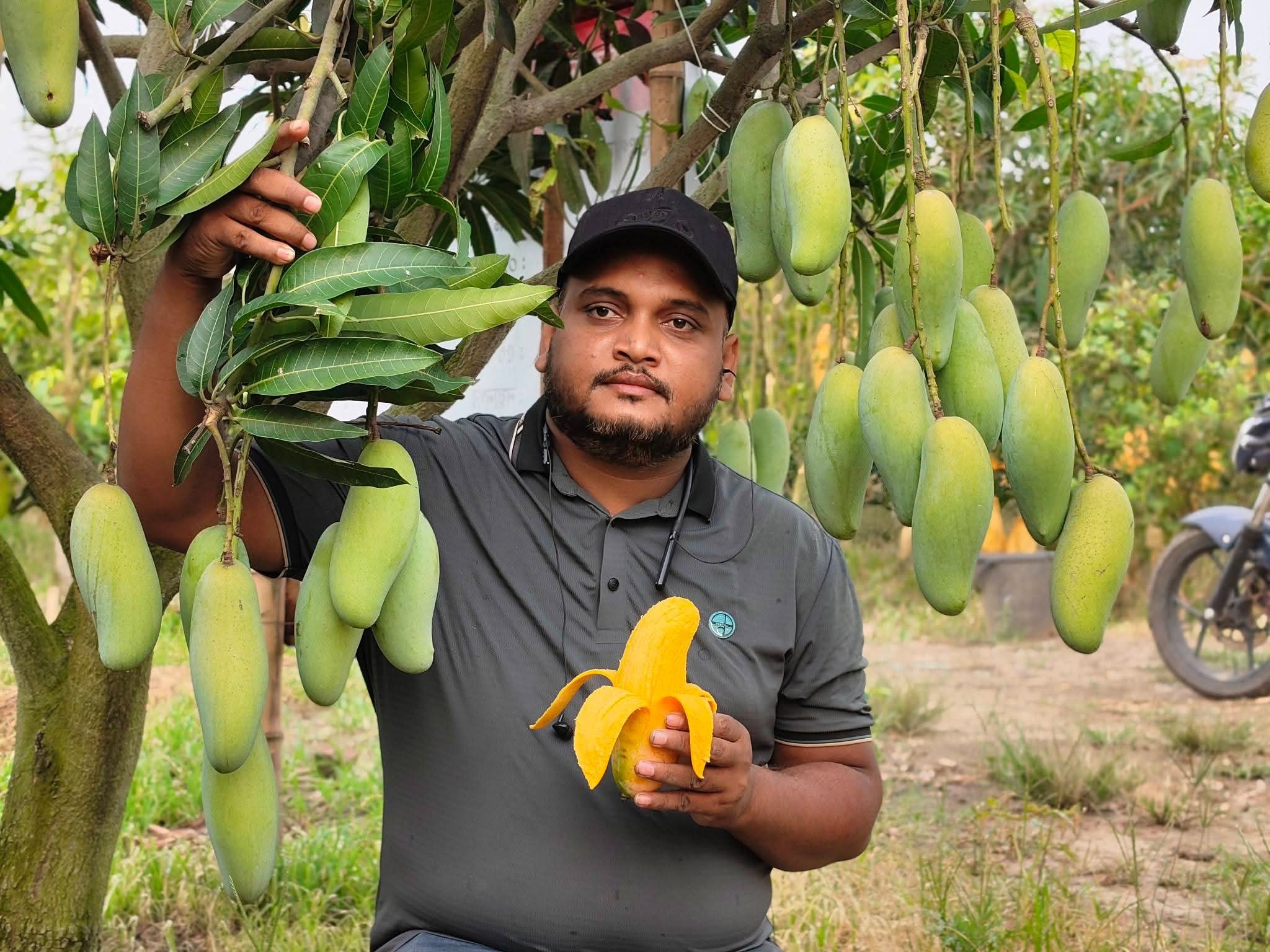
In Chapainawabganj, known as the mango capital of the country, there has been a lot of activity around mango production and marketing this season. Thousands of farmers, garden owners, workers and traders in the district are now busy collecting and selling mangoes. However, due to good production at the beginning of the season and intense heat, the supply of mangoes in the market has increased simultaneously. As a result, local farmers are afraid of losses as mangoes are being sold at comparatively low prices.
The business and agriculture department hopes that the market price and sale of mangoes will increase further in the coming days. However, according to farmers’ organizations, permanent improvement in the fortunes of mango farmers is not possible until the government takes initiatives in mango processing.
Current market price of mangoes and farmers’ disappointment:
Many varieties of mangoes have started to appear in various big mango markets and wholesale centers including Kansat in Chapainawabganj. Mangoes worth around Tk 15 to 25 crore are being sold in the district every day and an average of 200 trucks of mangoes are being sent to different parts of the country. Currently, different varieties of small mangoes are being sold in the market at Tk 700 to 800 per maund, Lakshmanbhog at Tk 800 to 900, Gopalbhog at Tk 1,600 to 2,400 and GI recognized Khirsapat at Tk 1,600 to 2,200. And after a week, Langra, Amrapali and Fazli mangoes will come to the market.
Mango farmer Rabiul Haque of Kansat said that the cost of production has increased by about 25 to 30 percent this year due to the increase in fertilizers, pesticides, irrigation and labor wages. However, mangoes are being sold in the market at a price of Tk 500 to 1,000 per maund compared to last year. As a result, farmers will have to bear huge losses if they do not get a fair price.
Picture of cultivation and yield:
Deputy Director of Chapainawabganj Department of Agricultural Extension Dr. Yasin Ali said that as new entrepreneurs have come forward in modern and commercial methods of mango cultivation, cultivation has increased in about 13,620 hectares of land in the district in the last 10 years. This time, a total of 37,487 hectares of land of various varieties of mango have been cultivated in 5 upazilas of the district, where the total number of mango trees is 8,52,490.
He expressed hope that if there are no natural disasters, there will be a bumper mango yield in the district this season and the mango-based business will be worth about 8 to 9 thousand crore taka, which was about 7 thousand crore taka last year. Although sufficient buds and pods came due to favorable weather at the beginning of the season, some mangoes were damaged later in some areas due to hailstorms, Kalbaishakhi storms and excessive temperatures.
Challenges of climate change and diseases:
Dr. Sharif Uddin, Chief Scientific Officer of Chapainawabganj Regional Horticulture Research Center (Mango Research Center), said that climate change has become a big challenge for mango production this time. Long periods of drought and sudden stormy weather have affected the orchards. In addition, many farmers have not been able to spray pesticides on time due to fuel shortages, resulting in outbreaks of hopper insects, anthracnose and powdery mildew. However, farmers are being advised regularly by the Agriculture Department and Mango Research Center. Thousands of tons of mangoes are being wasted in the district every year due to lack of storage and processing facilities, which could have been exported. Munjer Alam Manik, general secretary of Chapainawabganj Agricultural Association, said that while the global market for mango-based products is worth $28 billion, no major processing industry has developed in Bangladesh despite having sufficient raw materials.
Ismail Khan Shamim, general secretary of Shibganj Mango Producer Cooperative Society, said that there are no major initiatives to make mango juice, jelly, mango puree, powder, mango bars and mango jam, either publicly or privately. Due to lack of technology, training and investment, local small entrepreneurs are also unable to move forward on a large scale. Mizanur Rahman, owner of Gomostapur’s orchard, and Ahsan Habib, member secretary of Mango Foundation, said that the district produces 5 to 5.5 lakh tons of mangoes every year. If modern packaging houses, hot water treatment, and infrastructure are developed, it is possible to earn Tk 20,000 crore from this sector.
Export and marketing potential:
For the past few years, local entrepreneurs have been exporting mangoes to Russia, the Middle East, and several European countries. Last year, 144 farmers in this district exported 839 metric tons of mangoes to 21 countries following Good Agricultural Practices (GAP). This time too, representatives and exporters from various countries, including Malaysia, visited the orchards and expressed satisfaction. The Agriculture Department hopes that more mangoes will be exported this time compared to last time.
However, District Agricultural Marketing Officer Mominul Islam said that the lack of cold storage and mango spoilage during long-distance transportation are a major problem. For the benefit of farmers, 375 farmers and entrepreneurs are currently being trained in 15 schools so that they can get good prices by establishing direct links with super chain shops in Dhaka and Chittagong.
Abdul Wahed, president of the Chapainawabganj Chamber of Commerce and Industry, said that although mangoes have huge potential in the capital, there is a lack of proper planning. If government sponsorship is given to young entrepreneurs in mango export, processing and e-commerce and if industries are developed around mangoes, the fate of thousands of people in this region will completely change.