
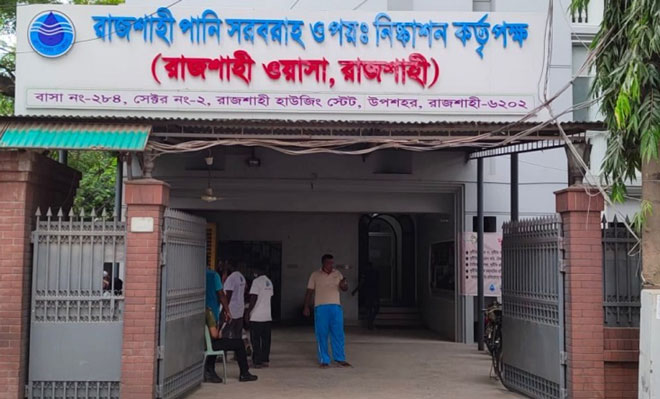
Despite spending crores of taka in the name of modernizing the water supply system of Rajshahi WASA, the expected benefits are not being achieved. Although automation system has been introduced in the lift pumps, they are still being operated manually. This is increasing the operational costs and losses every year. It is known that this organization under the Local Government Department has given subsidies worth more than hundreds of crores of taka in the last few years in the water supply sector alone.
Sources said that currently 121 WASA water lifting pumps are operational in Rajshahi metropolis. In addition, there is an above-ground water treatment plant on the banks of the Padma River in Shyampur of the city. Although the plant was built at a huge cost a few years ago, it is operational for only five months a year due to water shortage in the river. The rest of the time it remains idle.
Currently, 153 employees and workers are engaged in operating the WASA pump. Their salaries and allowances cost about 2.5 million taka per month. That means the annual expenditure is about 3 crore taka. In addition, the annual electricity bill for the water lift pump is about 9 crore taka. However, the officials concerned said that this expenditure is not covered by selling water.
It is known that about two years ago, automation technology was added at a cost of 4 crore taka to modernize the water supply system. Although a system to automatically control the pumps was introduced with the help of a technology company, it has not been implemented. Through the automation system, there is an opportunity to turn the pump on and off, control the flow of water and identify errors from a control room. But in reality, the pump operators are still manually managing the entire operation sitting in the pump house.
Officials claim that if automation is fully implemented, at least 125 pump drivers will be able to be redeployed to other jobs. This will reduce costs and increase production capacity. However, due to managerial weaknesses and lack of skilled manpower, the desired benefits are not being achieved.
Currently, the daily water demand in Rajshahi metropolis is 134.4 million liters. Against this, WASA is supplying about 86.5 million liters of water. Out of this, only 9 million liters of water is purified. The rest of the water is being pumped from underground and supplied directly to the customers.
Although the number of registered WASA customers is more than 53,000, there are about 35,000 illegal connections. The length of WASA pipeline in the metropolis is 860 kilometers. WASA costs 4 taka 56 paisa to extract and supply water per liter. However, it is sold to residential customers with a subsidy of 2 taka 27 paisa per liter. On the other hand, commercial customers have to pay 4 taka 54 paisa for each liter of water.
Rajshahi WASA Chief Engineer Parvez Mamud said, “The automation system is new to Rajshahi WASA. Therefore, the issue of hiring skilled manpower is being considered. It will be possible to gradually overcome these problems. In addition, costs can be saved by reducing unnecessary manpower.”