
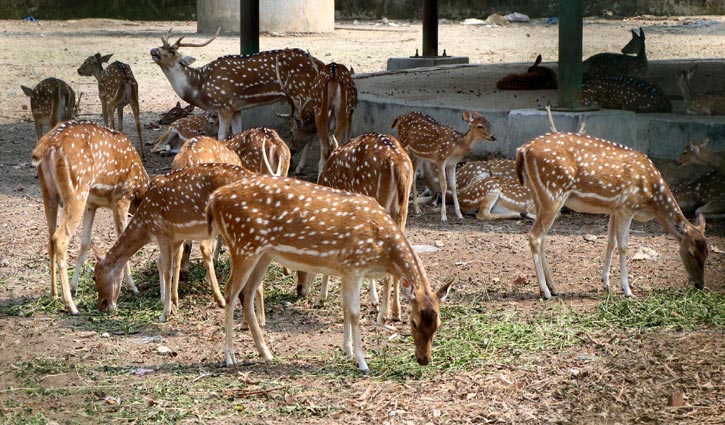
Where once crowds of visitors gathered to see tigers and lions, now the silence is broken only by the running of a few deer and the sound of pigeons’ wings. The traditional Central Park and Zoo of Rajshahi city is no longer the zoo it used to be. The name has changed, the appearance has changed, and the animals have gradually disappeared.
In 2023, the name of ‘Rajshahi Central Park and Zoo’ was changed to ‘Rajshahi Botanical Garden’. This time, Rajshahi City Corporation (RCGC) is once again walking the path of a new name. If the Ministry of Livestock approves, its new name will be ‘Rajshahi Bird Park’.
Rasik said that it is not possible to operate a large-scale zoo in the current reality. Therefore, considering the reality of limited space and few animals, a plan has been made to convert it into a park centered on bird sanctuary.
According to relevant sources, during the British period, the site of the present garden was a horse racing ground. Later, after it was abandoned for a long time, an initiative was taken to build a central garden and zoo here after independence. Formal activities began in 1972. In 1974, tree plantation, flower gardens, excavation of lakes and ponds, and construction of artificial hills began in the garden. Later, animals from home and abroad were brought in and it was developed into a full-fledged entertainment center. Since then, it has been known as ‘Rajshahi Zoo’.
Once upon a time, this zoo was home to a variety of wildlife, including tigers, lions, camels, hyenas, and bears. A six-year-old tiger brought from Dhaka in 1997 died in 2008 after living a lonely life for a long time.
Previously, a lion and a lioness were one of the zoo’s main attractions. When the lioness died in 2013, the lion also died a few days later. Two special cages built for bears are now abandoned memories. The last bear died of illness in January 2020.
Now the park has only two gharials, a few cheetahs, and about a hundred pigeons. Many of the other animals have been moved to different parks through donations or sales.
According to RASIC sources, two baboons, 13 monkeys, three Hanumans, a python and two Madantak birds have been donated to Swapnapuri Park. In addition, a Maya deer has been sold.
The total area of Rajshahi Central Park is about 33 acres. However, its area was reduced due to the construction of Bangabandhu Novotheater on about three acres of land during the Awami League government. In addition, a resort has been built inside the park.
According to officials of the RSK, it is almost impossible to run a modern zoo in its current size. As a result, a policy decision has been taken to develop it as a ‘bird park’.
During the previous government’s tenure, the park was beautified and infrastructurally developed at a cost of about 160 million taka. But even as the decorations increased, the number of animals continued to decrease. Currently, the animals are being fed and maintained somehow with the meager income from ticket sales, said those concerned.
Veterinary Surgeon of RSK Dr. Farhad Uddin said, “A letter has been sent to the Ministry of Livestock for a new project including a name change. If approved, the park will be newly decorated. Habitats and sanctuaries for different species of birds will be created there.” He also said that the initial plan will keep 10 to 15 species of colorful birds.
The park’s biggest crisis now is the number of deer. According to the park’s wildlife officer, there are 49 more deer than the park can hold.
Dr. Farhad Uddin said that according to the forest department rules, a deer needs at least 500 square feet of space. Accordingly, although the current shed can accommodate a maximum of 80 deer, there are 129 deer there.
He said that the food and care of the additional deer are becoming expensive. Therefore, a plan has been made to sell the additional deer at a fixed price with the permission of the forest department. However, there will be a condition – no one will be able to slaughter them, they will only be taken for raising. He also said that the Jalalabad Para Command Unit of Sylhet has already applied for five deer.
Meanwhile, the zoo’s most exceptional animals are now two gharials—the male named Garai and the female named Padma. Although Padma laid eggs last February, the staff did not notice it in time. As a result, the eggs sank into the water and were destroyed. The matter was later discovered when a rotten egg floated up.
Dr. Farhad Uddin said, “Gharials have the ability to reproduce once a year. This time we will be more careful. We will try to hatch the babies by storing the eggs in an incubator.”