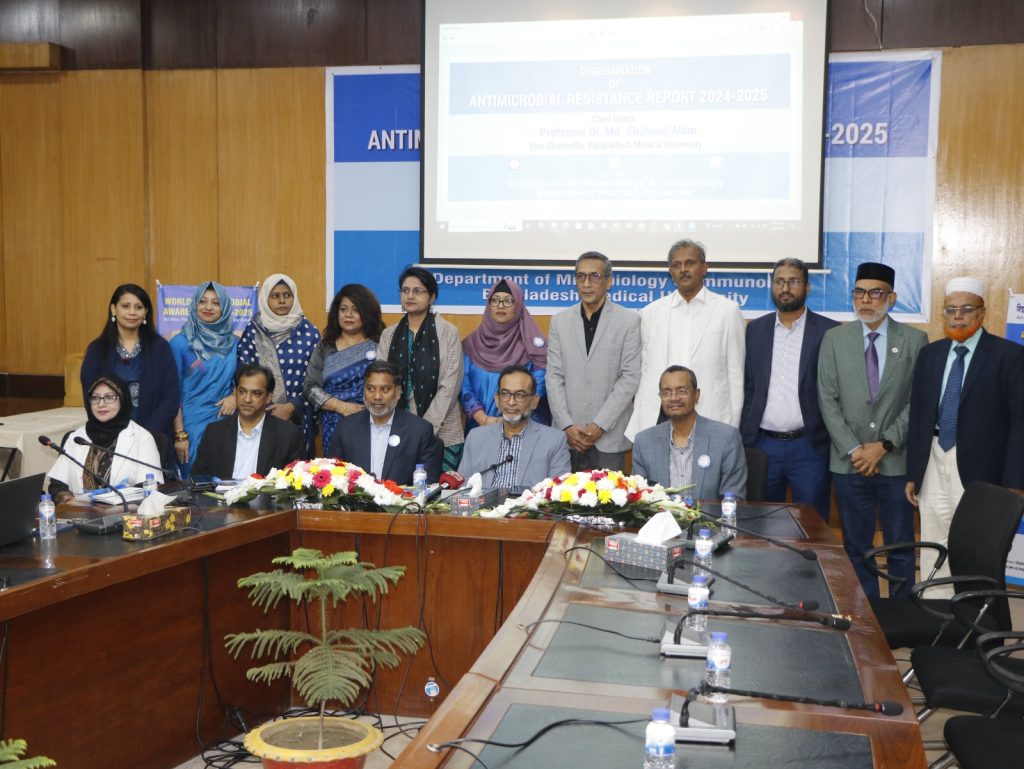

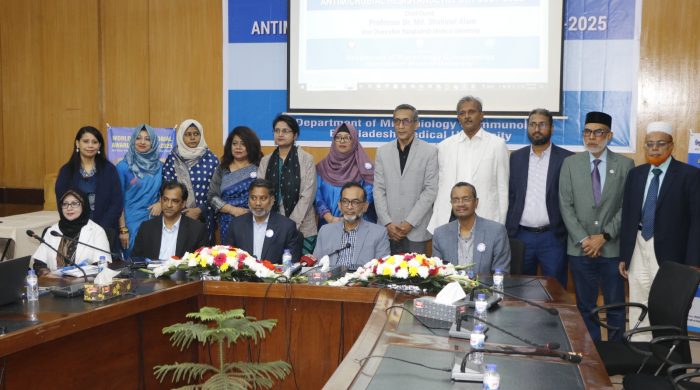
In the last one year, 46,279 samples of different patients were analyzed by the Department of Microbiology and Immunology at Bangladesh Medical University (BMU). Where it is seen that due to the indiscriminate use of antibiotics against bacteria, viruses, fungi, many drugs including ciprofloxacin, amoxicillin, cephalosporin, gentamicin, meropenem, tigecycline are not working or due to resistance in the patient’s body, all these antibiotics or drugs are becoming ineffective. Which is prolonging the patient’s disease treatment, even leading to the death of the patient instead of recovering. Antimicrobial resistance is when microorganisms such as bacteria, viruses, fungi or parasites are no longer killed or their growth is not inhibited by antimicrobial drugs (antibiotics, antivirals, antifungals, etc.), resulting in the infection becoming difficult to cure, which is a serious threat to public health worldwide and disrupting the medical system. This is mainly due to the misuse or overuse of medicines, due to which microorganisms mutate and become drug-resistant, and even common infections can become fatal. This information was given at the Antimicrobial Resistance Report 2024-2025 release ceremony on the occasion of World Antimicrobial Awareness Week 2025 at Bangladesh Medical University (BMU)yesterday, Monday, December 8, 2025.
The awareness week 2025 was celebrated under the slogan ‘Take action now, protect our present, secure our future’ by the Department of Microbiology and Immunology, BMU. The main objective of this event is to increase public awareness to combat the growing threat of antimicrobial resistance (AMR), rational use of antibiotics, prevention of infections, and increase community involvement in protecting the future of healthcare. The chief guest was the Vice Chancellor of BMU, Professor Dr. Md. Shahinul Alam. The chairman of the Department of Microbiology and Immunology, Professor Dr. Abu Naser Ibne Sattar, presided over the event.
In a video message at the event, Professor Dr. Md. Sayedur Rahman, Special Assistant to the Honorable Chief Advisor and State Minister, said, “Once upon a time, people were defeated by bacteria because they did not have enough drugs to fight them. In the next 10 to 15 years, humanity may face the same crisis again. However, this time there will be drugs, but they will not be effective against bacteria. Therefore, antimicrobial resistance is now being considered a ‘great disaster’ worldwide.”
It was informed at the event that the Vice-Chancellor of BMU, Professor Dr. Md. Shahinul Alam, has strengthened the university’s strategic initiative to prevent antimicrobial resistance and provided continuous guidance and support in publishing this report. In his speech as the chief guest, Vice-Chancellor Professor Dr. Md. Shahinul Alam said that universities must take responsibility for the problem and the solution. BMU, as a medical university, must lead in research, guideline formulation, and implementation in the field of antimicrobial resistance. It is not impossible to face the challenges of antimicrobial resistance. It must be remembered that it is the responsibility of the university to find solutions even for those that cannot be solved. By fulfilling that responsibility, the nation must show the light of hope to the people.
Pro-Vice Chancellor (Administration) Professor Dr. Md. Abul Kalam Azad said, “Antimicrobial resistance has become a serious issue. To address this public health issue, everyone must take necessary initiatives and implement them now without delay.”
The event’s chairman, Professor Dr. Abu Naser Ibn Sattar, Chairman of the Department of Microbiology and Immunology, said, “Antimicrobial Resistance (AMR), which is currently one of the biggest threats to global public health. Due to unnecessary use of antibiotics, self-medication, incomplete dosage, and overuse of antibiotics in livestock, microbes are gradually becoming resistant to drugs. As a result of AMR, diseases that were previously easily cured are now becoming difficult to treat. Common infections become complicated, treatment costs increase, and ICU admissions and deaths are all increasing due to the misuse of antibiotics. Therefore, today we must resolve to use antibiotics consciously, and not take medicines on our own, but on the prescription of a doctor. Hand washing, vaccination, safe food, cleanliness, and proper infection control are all very important in preventing antimicrobial resistance. If we all are responsible, we can gift a safe healthcare system to future generations.”
Dean Professor Dr. Md. Ibrahim Siddique, Dean Professor Dr. Md. Atiar Rahman, Dean Dr. Sakhawat Hossain Sayant, Chairman of the Neonatal Department Professor Dr. Md. Abdul Mannan, Chairman of the Department of Pediatric Hematology Oncology Professor Dr. Md. Anwarul Karim, Chairman of the Department of Transfusion Medicine Professor Dr. Ayesha Khatun, Chairman of the Department of Gynecological Oncology Professor Dr. Jannatul Ferdous, Chairman of the Department of Laboratory Medicine Professor Dr. Md. Saiful Islam, Chairman of the Department of Biochemistry Professor Dr. Naila Atiq Khan, Chairman of the Department of Pharmacology Professor Dr. Elora Sharmin, Director of the Hospital Brigadier General Irteka Rahman, Associate Professor of the Department of Microbiology Dr. Shaheda Anwar, Associate Professor Dr. Chandan Kumar Roy, Public Health Specialist Dr. Farzana Islam, among others, were present at the event and provided valuable opinions.
The Department of Microbiology and Immunology (BMU) has published a comprehensive antimicrobial resistance analysis report as part of the annual Antimicrobial Resistance Report 2020-2025 Dissemination Program (ARDR) held in conjunction with the World Antimicrobial Awareness Week 2025. The key statistics and scientific findings were presented by Dr. Shaheda Anwar, Associate Professor, Department of Microbiology and Immunology. The report states that the quality of the data has been maintained through regular training, monitoring, EQAS participation and strict internal quality control.
A total of 46,279 samples were analyzed at BMU in 2024-25; of these, 11,108 (24 percent) were culture positive. Urine samples were the most common, followed by blood. The main pathogens in urine were E. coli (E. coli) and in blood, Salmonella typhi (S. typhi) were the most common. In blood, Salmonella typhi (S. typhi) had the highest resistance to ciprofloxacin (Ciprofloxacin). However, resistance against P. spp. and P. spp. was relatively low. Some isolates are also resistant to penicillin, indicating the need for genetic sequencing to understand clonality. 5. Resistance to penicillin and amoxicillin (antibiotics) has increased significantly in the Pneumonia and Central Nervous System, although penicillin and amoxicillin are still effective. Resistance to cephalosporins (antibiotics), gentamicin (antibiotics) and penicillin is moderate to high in the Klebsiella pneumoniae (a type of bacteria that causes pneumonia and urinary tract infections). However, resistance is increasing in this case, although penicillin and amoxicillin are still effective. In addition, high levels of resistance to almost all common antibiotics are observed in the U.S., even to meropenem (Septra) and tigecycline (Rampicillin), especially in hospital-acquired infections. In the 2022 to 2025 trend analysis, although MRSA and urinary ESBL-producing U.S. bacteria have decreased slightly, carbapenem resistance has increased at an alarming rate in U.S. bacteria, carbapenems, U.S. bacteria, and other pathogens. In ICU-centered invasive candidemia, E. coli and E. coli strains were found to be the most common. Antimicrobial resistance was significant in various species, especially E. coli, E. coli, E. coli, E. coli, E. coli.
Professors of the Department of Microbiology and Immunology of BMU, Dr. Abu Naser Ibne Sattar, Dr. Chandan Kumar Roy, Dr. Shaheda Anwar, Dr. Sanjida Khandaker Setu, Dr. Ismet Nigar, Dr. Rehana Razzak Khan and Dr. S. M. Ali Ahmed, among others, contributed to the preparation of this report and were present at the event. In addition, MD Resident Doctors and Lab Technologists of the Department of Microbiology also played an important role in data collection, laboratory analysis and compilation and were present at the event. Awards were distributed among the winning doctors in the poster presentation event on antimicrobial resistance at the event. Edited by Dr. Saiful Azam Ranju.
Chairman Editorial Board : Md. Shajahan Mia
Chief Editor : Md. Humayoun Rashid, Editor : Ayub Ali Sarder
Publisher : Tahmina Akter Saima
Office : Motaleb Mansion (5th Floor), 2 R. K. Mission Road, Dhaka -1203 Phone : 01711681147,01710453070
Email : morningobserver@gmail.com
All rights reserved © 2025 dailymorningobserver