
The world’s climate change crisis is a
security issue that belongs on the desks of generals and prime ministers, not
just green campaigners, Britain’s foreign minister said Monday, as world
leaders convene for the UN General Assembly’s high-level week.
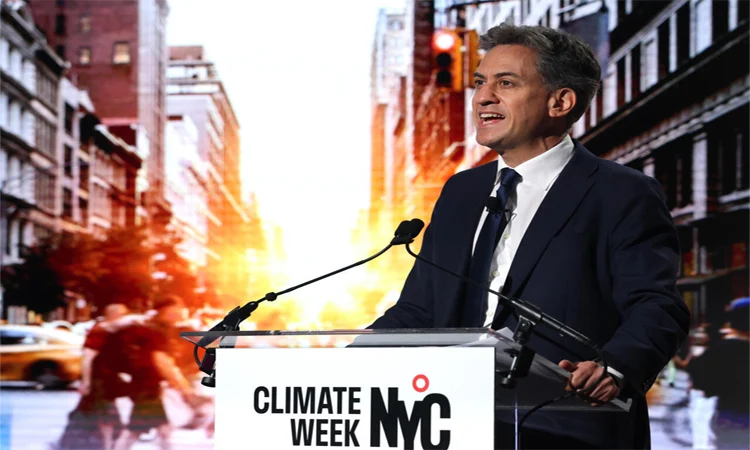
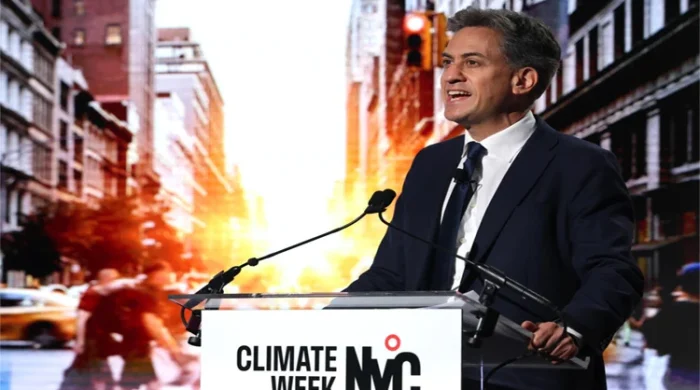
Speaking at the opening ceremony of Climate Week NYC, Ed Miliband argued that
the “fossil fuel roller coaster” — with supply disrupted after Russia’s
invasion of Ukraine and the United States’ war in Iran — underlined “the
energy independence imperative of clean energy.”
“Climate breakdown, in my view, must be an issue for foreign ministers and
prime ministers, as well as energy and climate ministers — the security
community, not just the activist community — the generals, not just the
green campaigners,” he said.
Miliband was named foreign minister under Britain’s new Prime Minister Andy
Burnham after serving as energy security and net zero minister. He first took
on a climate brief in 2008, when the issue was still treated as peripheral.
That is no longer possible, he said, pointing to a northern hemisphere summer
of record heat and wildfires, Nepal’s devastating floods triggered by glacial
collapse, as well as a record-breaking El Nino weather pattern.
Climate and nature must be embedded in a country’s national security systems
and threat assessments, he said, and “countries need to pool information
because a shock beginning in one country can rapidly travel through supply
chains, financial markets, and migration patterns.”
Miliband spoke after Australian Prime Minister Anthony Albanese opened the
talks with a call to action, giving the example of how his country’s heavily
fossil fuel dependent economy was now seeing record uptake of renewables —
clean energy accounted for over half the grid at the peak of the last
Australian summer.
“There’s no avoiding the scale of our responsibility or the cost of
inaction,” he said.
– Focus on AI –
Climate change has been a signature issue for outgoing UN chief Antonio
Guterres, who has convened a summit on Wednesday bringing together world
leaders on the road to the COP31 climate talks to be held in Turkey in
November, with Australia steering negotiations.
Turkey said Monday it would be pursuing “climate-responsible AI” and pushing
tech companies to power data centers with clean energy.
COP31 President and Turkish Climate Minister Murat Kurum announced that the
summit would also address “growing fears over the rise of AI” and its carbon
footprint.
“We must openly discuss AI’s growing energy consumption and it is time for
governments to start setting the terms,” he said in a statement.
“We expect companies to be transparent about their energy use and to power
their operations with clean energy.”
Amid the grim outlook, there are glimmers of hope. The world added a record
693 gigawatts of renewable power in 2025 — over half the installed capacity
of the United States — according to a report by the International Renewable
Energy Agency (IRENA).
UN climate chief Simon Stiell hailed it as a sign that the “brute power of
market forces” is making the clean energy transition irreversible.
Even so, meeting the global goal of tripling renewable energy by the year
2030 — a key target agreed by countries at the COP28 talks held in 2023 —
would still require more than doubling today’s levels.
Chairman Editorial Board : Md. Shajahan Mia
Chief Editor : Md. Humayoun Rashid, Editor : Ayub Ali Sarder
Publisher : Tahmina Akter Saima
Office : Motaleb Mansion (5th Floor), 2 R. K. Mission Road, Dhaka -1203 Phone : 01711681147,01710453070
Email : morningobserver@gmail.com
All rights reserved © 2025 dailymorningobserver