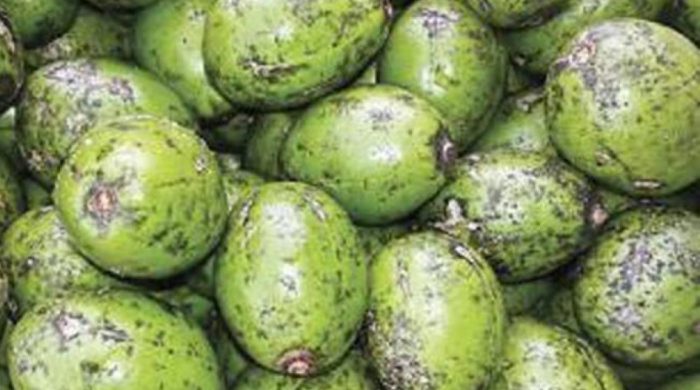


Rows of betel nut trees lining homesteads, courtyards, ponds and village roads are a familiar sight across rural Barishal.
Once grown mainly for household consumption, betel nut cultivation has gradually emerged as an important source of additional income for thousands of families in the division.
Beyond homestead cultivation, commercial farming of the crop is also expanding, turning betel nut into an increasingly promising cash crop and an important component of the rural economy.
According to production data of the Department of Agricultural Extension (DAE) for the 2025-26 fiscal year, betel nut was cultivated on 22,846 hectares of land in six districts of Barishal division, producing 108,666.2
metric tonnes of the crop.
Bhola is leading the division in betel nut production. The district has around 13,500 hectares under cultivation, producing nearly 68,000 tonnes of betel nut, accounting for a major share of the division’s total output.
Pirojpur ranks second, producing around 17,071 tonnes from 4,579 hectares. Patuakhali produced 15,339 tonnes from 1,548 hectares, while Barguna produced nearly 5,670 tonnes from 810 hectares.
Jhalkathi produced around 8,666 tonnes from 481 hectares, while Barishal district produced nearly 1,720 tonnes from 1,544 hectares.
One of the distinctive features of betel nut cultivation in Barishal is that it does not necessarily require separate agricultural land. Trees are commonly grown in courtyards, around ponds, in vacant spaces within
homesteads and along field boundaries.
This allows families to generate income from land that might otherwise remain unused.
Farmer Jabbar said, “We meet our family’s needs with the betel nuts produced on our homestead and sell the surplus. The money helps us meet various household expenses.”
Shahobdul Islam of Laharhat and Saddam Hossain of Dapdapia said the current market for betel nut is good. They are earning additional income by selling part of their production after meeting their household requirements.
The growing betel nut trade is benefiting not only growers but also local traders, wholesalers, labourers and people involved in transportation.
During the harvesting season, traders collect betel nuts from villages and take them to local markets and wholesale centres. From there, the crop is supplied to different parts of the country.
Thus, a betel nut tree is no longer simply a source of income for an individual family. Its production has created a wider economic chain involving cultivation, harvesting, collection, transportation, trading and
distribution.
Farmers say betel nut is relatively profitable because of its year-round demand. The soil and climate of Barishal are also highly favourable for its cultivation, creating considerable scope for further expansion.
However, growers and agriculture officials believe that greater attention is needed to disease and pest management, supply of improved planting materials, modern cultivation practices, storage and marketing.
Ensuring fair prices for farmers is also essential to sustain their interest in the crop.
Additional Director of DAE in Barishal division Mohammad Rafiqul Islam said the soil and climate of the region are highly suitable for betel nut cultivation.
“Both production and the economic importance of betel nut are increasing in the region because of its cultivation on homesteads as well as commercially,” he said.
He said there was further scope to increase production through improved varieties, proper care, disease and pest management and the use of modern technologies.
“If effective initiatives are taken for training farmers, providing necessary technical advice, and improving storage and marketing facilities, betel nut can play a much bigger role in the rural economy,” he added.
Agricultural experts also believe that betel nut production in the division can be increased through planned expansion of cultivation, the supply of improved saplings, farmer training and wider use of modern technologies.
At the same time, establishing better storage and processing facilities could reduce post-harvest losses and enable farmers to secure better prices.
The current production figures underline how far betel nut has moved beyond its traditional role as a homestead tree in Barishal.
With more than 108,666 tonnes produced from 22,846 hectares, the crop is emerging as an increasingly important economic asset for rural communities across the division.
With planned government support, improved cultivation practices, better post-harvest management and a farmer-friendly marketing system, betel nut has the potential to become one of the major cash crops of Barishal division, contributing further to rural incomes and the regional economy.
Chairman Editorial Board : Md. Shajahan Mia
Chief Editor : Md. Humayoun Rashid, Editor : Ayub Ali Sarder
Publisher : Tahmina Akter Saima
Office : Motaleb Mansion (5th Floor), 2 R. K. Mission Road, Dhaka -1203 Phone : 01711681147,01710453070
Email : morningobserver@gmail.com
All rights reserved © 2025 dailymorningobserver