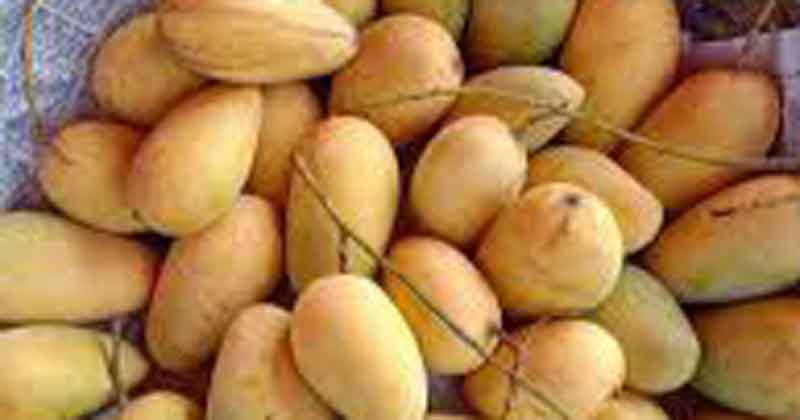

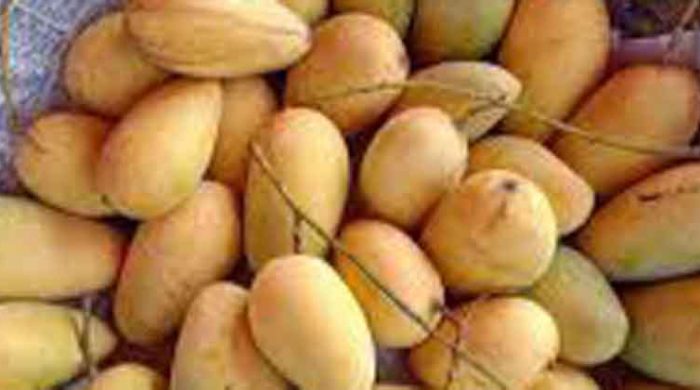
According to Godagari Upazila Agriculture Officer Maryam Ahmed, Katimon or Sweet Katimon is a species brought from Thailand. Unlike the indigenous varieties, it has a lot of commercial potential as it can be cultivated all year round. There is a demand for this mango in the market even outside the season, so the price is good. Farmers can collect mangoes twice a year. That is why interest in Katimon cultivation is increasing day by day.
On a field visit last Friday, it was seen that there are numerous Katimon mango orchards in Barendrabhumi of Godagari and on both sides of the road from Mundumala to Kalma in Tanor Upazila. Especially in various upazilas including Godagari, Chapainawabganj, Naogaon and Rajshahi, hundreds of Katimon mangoes are hanging in bunches in different gardens, which is heartwarming.
Mangoes hanging from small trees can be seen in a garden on the Amanura-Nachol-Adda road in Chapainawabganj Sadar Upazila, the Porsha-Niamatpur road in Naogaon, or the Lakshipur intersection in Nachol Upazila, attracting the attention of passersby.
Farmer Md. Mizanur Rahman, owner of the orchard in Bishwanathpur Bazar area of Godagari upazila, said, “Katiman ripe mangoes are sweet, small in size, have no smell, are in high demand, and are as sweet as sugar when eaten.” I have Katimon mangoes, Gaurmati, and Ilamati in my 50 bigha mixed orchard. I have been cultivating these mangoes for the past few years. Although the yield is low, I am very happy with the price I get. He said, officials from various departments, employees, journalists, teachers, students, ministers, MPs, industrialists, businessmen, farmers, and people of various professions have come to my mixed orchard. They have come to the orchard and praised it. They enjoy it.
He also said that mangoes are being sold at wholesale prices in the market at Tk 200-300 per kg. He earns several lakhs of taka by harvesting mangoes twice a year.
Tabarak Hossain, a farmer from Tanor upazila of Rajshahi, said that earlier he used to cultivate indigenous varieties of mango (Gopal Bhog, Nengda, Ghirsa). But since they were not profitable compared to the cost, he cut them down and now has about 2,500 Katimon trees on 25 bighas of land. He is expecting a good harvest this year.
Sumon Ali, a mango seller in Mahishalbari Bajra of Godagari Municipality, Rajshahi, said, “I could not sell Khirsa, Gopalbhog, Langa mangoes for 25 to 50 taka per kg. I could not make a profit, I almost lost money. Thai variety Katimon mangoes are sweet, delicious, have no smell, and are very thin in demand. They are being sold at 250 to 330 taka per kg. The Katimon mango season begins after the mango season ends. So even though the price is high, everyone wants to taste these mangoes.”
Deputy Assistant Agricultural Officer Atuno Sarkar said, Sweet Katimon Mango (Jhabib: Kadharasaraha) is basically a Thai perennial mango variety, available all year round. These mangoes are very sweet, fiberless, and their rind is quite thin. In addition, since the tree is small, it can be easily cultivated in a roof garden or tub. Fruit characteristicsTaste and aroma: The mangoes are very sweet and juicy, and even when raw, they do not have any sourness or sweetness. It has a wonderful aroma. The rind or seed of the mango is very thin. Any pedestrian who walks along the rural roads of the Barendra region will see small and large gardens full of mangoes. Even though the season is over, the Katimon mangoes hanging on the trees remind us that there is a mango festival in Barendra all year round.
Chairman Editorial Board : Md. Shajahan Mia
Chief Editor : Md. Humayoun Rashid, Editor : Ayub Ali Sarder
Publisher : Tahmina Akter Saima
Office : Motaleb Mansion (5th Floor), 2 R. K. Mission Road, Dhaka -1203 Phone : 01711681147,01710453070
Email : morningobserver@gmail.com
All rights reserved © 2025 dailymorningobserver