Fraud and human trafficking are increasing as Chinese nationals marry in Bangladesh
Aminul Islam Ahad Brahmanbaria:
/ ৫৮
Time View
Update :
সোমবার, ২০ জুলাই, ২০২৬
Share
Fraud and human trafficking are increasing as Chinese nationals marry in Bangladesh
The recent cross-border marriages of Bangladeshi women with Chinese citizens in Bangladesh have been in the news. While some legitimate marriages are taking place through acquaintances, work connections or personal relationships on social media, allegations of fraud and human trafficking under the guise of marriage have also raised concerns. In the meantime, a young man from China who came to Bangladesh for love and converted to Islam in Brahmanbaria's Kasba Upazila has married a young Bangladeshi woman. It is learned that Sohan Chao (38), a resident of Nanyang City in Henan Province, China, who was named Mohammad after converting to...
৯২
The recent cross-border marriages of Bangladeshi women with Chinese citizens in Bangladesh have been in the news. While some legitimate marriages are taking place through acquaintances, work connections or personal relationships on social media, allegations of fraud and human trafficking under the guise of marriage have also raised concerns. In the meantime, a young man from China who came to Bangladesh for love and converted to Islam in Brahmanbaria’s Kasba Upazila has married a young Bangladeshi woman.
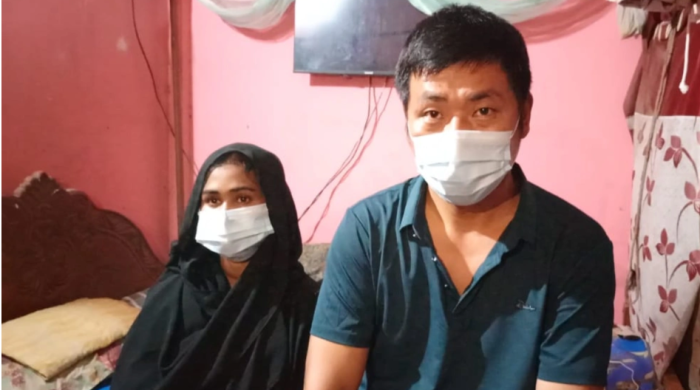
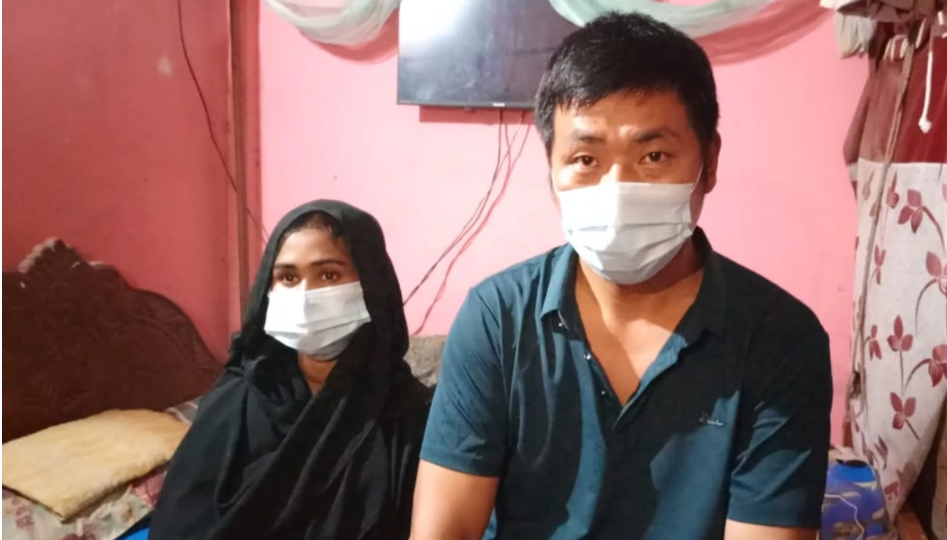
It is learned that Sohan Chao (38), a resident of Nanyang City in Henan Province, China, who was named Mohammad after converting to Islam, has married Ayesha Sultana (21), daughter of Abdul Alim of Baisar Village, Kuti Union, Kasba Upazila.
According to family and local sources, Sohan Chao and Ayesha Sultana met on an online social media platform “Walltop” about three months ago. At one point, they developed a romantic relationship through regular conversations. Based on that relationship, Sohan Chao came to Bangladesh on June 12. Ayesha herself brought him from the airport to his village home. Then, on June 14, they went to Dhaka.
Ayesha Sultana said that the necessary legal procedures were completed through High Court lawyer Lima Akhter in Dhaka. At that time, Sohan Chao’s father Songfu Fang was also spoken to. Later, with the consent of the family, Sohan Chao voluntarily converted to Islam. After converting, he was named Mohammad. After that, their marriage was completed according to Islamic Sharia and legal procedures.
After their marriage, they lived in Dhaka for more than a month. Later, last Thursday, Sohan Chao and his wife came to their in-laws’ house in Baisar village of Kasbar. When the matter became known in the area on Saturday afternoon, hundreds of eager people gathered at the house to catch a glimpse of the Chinese young man. Many took pictures and videos and spread them on social media.
Ayesha Sultana said, “Our relationship is based entirely on mutual love. We got married with the consent of our families.”
Ayesha’s father Abdul Alim said, “She came to Bangladesh on June 12. Later, she went to Dhaka and made necessary inquiries through a lawyer. After she voluntarily converted to Islam, I married her to my daughter. Currently, the work of preparing the girl’s documents is underway. Once everything is completed, he will take my daughter to China. I married her knowingly.”
In this regard, Advocate Kazi Islam Uddin Dulal, president of Brahmanbaria human rights organization Human Society, told the daily Kaler Samaj, “Under the prevailing law of Bangladesh, there is no legal obstacle to marriage between a foreign citizen and a Bangladeshi citizen. However, there must be voluntary consent from both parties, identity verification, and completion of the necessary legal procedures.”
According to relevant sources, there are no specific official statistics on the marriage of Chinese citizens with Bangladeshi women in Bangladesh. However, several such marriages have been reported at different times. In 2023, Chinese citizen Sawi Cui married Faria Sultana of Gayeshpur, Chuadanga. On the other hand, an investigative report in 2024 revealed that some women from some areas, including Chuadanga, were taken to China under the pretext of marriage and tortured and sexually exploited. Allegations of involvement of human trafficking rings in these incidents also came under investigation.
As the issue has gained more importance in recent times, the Chinese Embassy in Dhaka warned its citizens in July 2026 that trying to find a wife in Bangladesh through illegal brokers or matchmaking circles could lead to arrest and legal complications on charges of human trafficking. The embassy said that cross-border marriages must be concluded with the free consent of both parties, genuine relationships, and in accordance with the laws of the two countries involved.
According to experts, inter-country marriage is not a crime in itself. However, it is important to verify identities, follow the necessary legal procedures, and be aware of the risks of human trafficking or fraud in relationships formed through social media. At the same time, they have also urged law enforcement surveillance and increased public awareness.