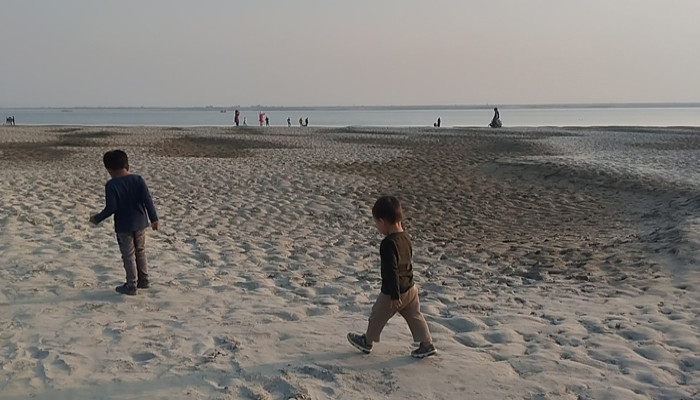

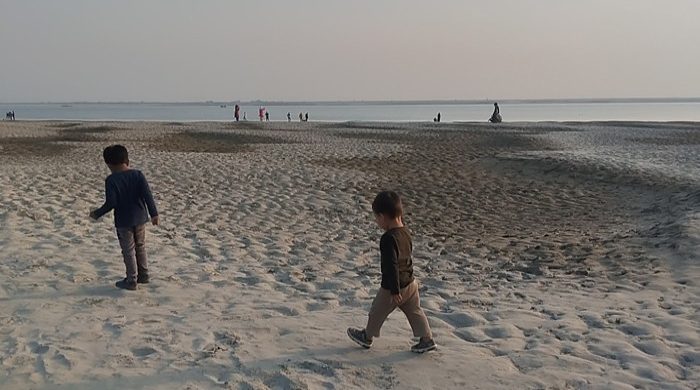
The Padma River flowing near Rajshahi city is no longer as fast as it used to be. This major river of the country has dried up and numerous chars have emerged. Sand and silt have accumulated on the riverbed. Where boats used to ply, tractors are now plying. Various types of crops are being cultivated on the chars of the river. Not only the Padma, but most of the rivers in the Rajshahi region have become dry due to the impact of Farakka Barrage. Many rivers including Atrai, Chhota Jamuna, Tulshiganga, Shivnad, Nagar rivers are losing their tradition and existence due to encroachment, pollution and navigability crisis.
People dependent on the river have been the most affected by the decrease in water. Jatin from Kumarpara area of Rajshahi city said that he used to earn a living by fishing in the river. Now, due to the lack of water and fish in the river, they are forced to pull rickshaws. The same is the case with many fishermen. Many have taken up the profession of daily laborers or rickshaw pullers in the city, after spinning boats and nets.
The once fast-flowing Chak River in Manaksha Union of Shibganj Upazila of Chapainawabganj is now almost gone. This river, about 12 to 15 kilometers long, once flowed over Manaksha, Binodpur and Durlavpur Unions and merged with the Pagla River. A prosperous township, educational institutions, bazaars and boat trade developed around the river. According to local elders, there was water in the river all year round, people used to bathe, fish, and travel by boat. Currently, rice, corn, jute and vegetables are being cultivated along the river.
Locals allege that after the construction of the Farakka Barrage, the flow of the Chak River stopped due to the change in the flow of the Padma. Then a class of land grabbers occupied the land of the river and built houses. The river has become silted up due to lack of dredging for a long time.
Abdul Halim, Abu Hossain, freedom fighter Moazzem Hosne Montu and Badiur Rahman, senior residents of Manaksha area of Chapainawabganj, said that once there was water in this river all year round. Now the river is just a dead canal.
Environmentalists say that the river is not just a source of water; it is an important part of the biodiversity, agriculture and economy of a region. As the river dries up, native fish species are decreasing, the habitat of aquatic animals is being destroyed and the risk of waterlogging is increasing.
Mazharul Islam, Executive Officer of Shibganj Upazila of Chapainawabganj, said that he has learned something new about the river. Necessary measures will be taken after a quick inspection. SM Ahsan Habib, Executive Engineer of the District Water Development Board, said that initiatives will be taken to reclaim the river land and dredge it with the help of the local administration.
On the other hand, among the 19 rivers in Natore district, the Narad and Boral rivers are in the worst condition. Influential people are also occupying the Baronai and Musa rivers. Most of the major canals in the district have also been occupied. Hundreds of shops have been illegally built in front of Lalon Shah Muktamancha in the Padmapar area of Rajshahi city. Locals are cultivating rice and fish by building dams on the Baral, Narad and Huja rivers. Agricultural production is also being disrupted as the city’s sewage-laden water flows into the Baronai river.
Rajshahi Water Development Board Executive Engineer Arifur Rahman Ankur said that a list of 1,612 illegal encroachers has been prepared in the metropolis. An eviction drive will be conducted soon.
Rajshahi Divisional Commissioner ANM Bazlur Rashid said that under the government’s instructions, renovation and excavation work has started to free the encroachments of dying rivers and canals. Projects will be implemented to restore all rivers and canals in phases.
According to the Water Development Board, more than 40 rivers and canals in Rajshahi division are currently in a state of existential crisis due to encroachment and pollution. However, these rivers were navigable even two decades ago.
Meanwhile, the celebration committee has announced a mass gathering in Rajshahi to mark the 50th anniversary of the historic Farakka Long March. The leaders have alleged that the Farakka barrage has reduced the flow of Ganga-Padma, putting the environment, agriculture, biodiversity and livelihood of people in the north and south in serious crisis.
Environmentalist and leader of the Save the River Movement Rajshahi, Advocate Enamul Haque, said that India is unilaterally diverting water from common rivers, ignoring international laws and customs. As a result, the Padma and its tributaries are drying up before the dry season.
It was informed at the press conference that on January 1, 2023, the flow of water in the Ganga was 90,730 cusecs. On the same day in 2024, it decreased to 75,409 cusecs. The flow has decreased by 15,321 cusecs in just one year.
The proposed Padma Barrage project is showing a ray of hope in this situation. Those concerned believe that if the monsoon water is stored through this barrage under construction in Pansha, Rajbari, there will be positive changes in agriculture, irrigation and biodiversity in the Rajshahi region.
Rezaul Karim, Deputy Assistant Engineer of the Water Development Board, said that if the Padma Barrage is implemented, dependence on groundwater will be reduced and it will be possible to irrigate using surface water. At the same time, adequate water supply will be ensured at the Rooppur Nuclear Power Plant.
Abu Taher, a farmer from Baragachi village in Godagari, Rajshahi, said that if there is water in the Padma, there will be no crisis in deep tube wells. It will also be beneficial for farming. Abdul Bashir, a farmer from Bagha Upazila, said that there is no water in the Padma during the winter, farming is problematic. If water can be retained, farmers will benefit the most.
River researcher Mahbub Siddiqui said that if the Padma Barrage is built, it will be possible to maintain the water level of the river from Rajshahi to Chapainawabganj. This will keep the rivers flowing smoothly during the dry season and reduce the water crisis in the northwestern region to a great extent.
Chairman Editorial Board : Md. Shajahan Mia
Chief Editor : Md. Humayoun Rashid, Editor : Ayub Ali Sarder
Publisher : Tahmina Akter Saima
Office : Motaleb Mansion (5th Floor), 2 R. K. Mission Road, Dhaka -1203 Phone : 01711681147,01710453070
Email : morningobserver@gmail.com
All rights reserved © 2025 dailymorningobserver