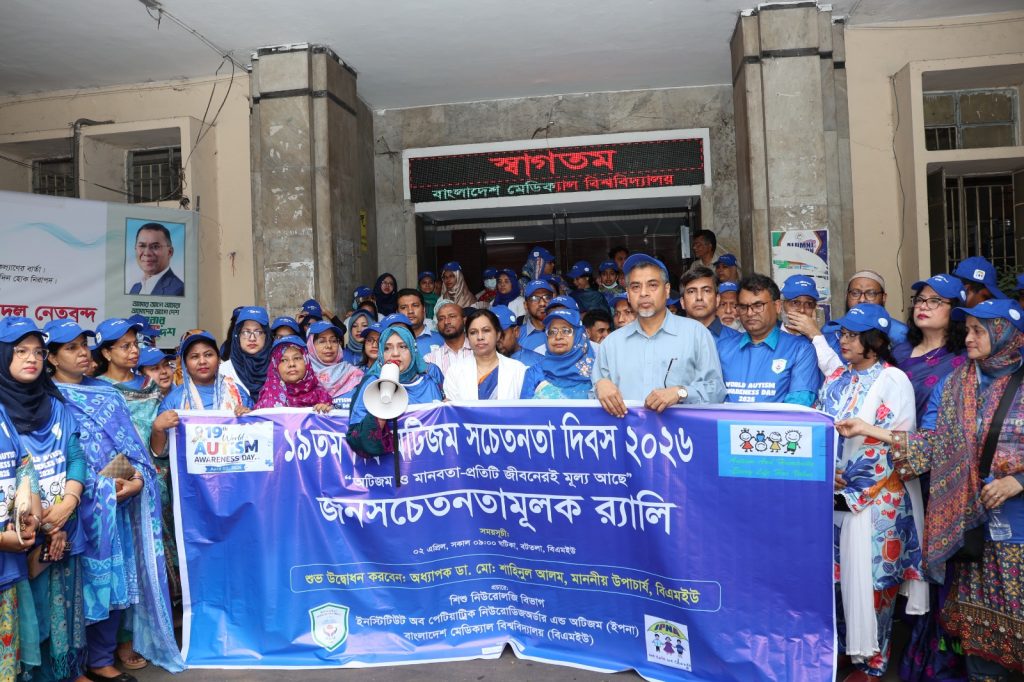

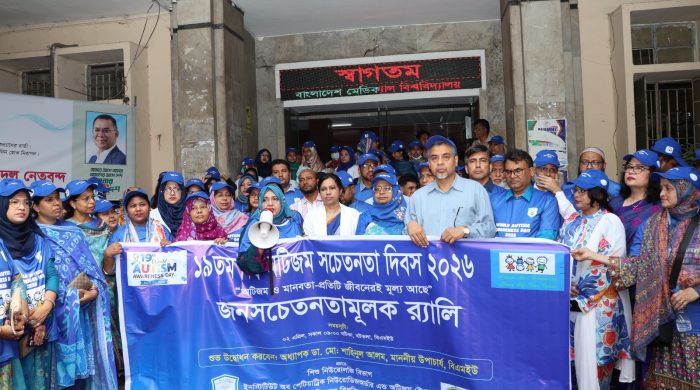
The 19th World Autism Awareness Day was celebrated Thursday, April 2, 2026, with various events including rallies, seminars, and painting competitions at Bangladesh Medical University (BMU). Organized under the slogan Autism and Humanity – Every Life Has Value, these programs were attended by BMU Pro-Vice Chancellor (Administration) Professor Dr. Md. Abul Kalam Azad, Pro-Vice Chancellor (Research and Development) Professor Dr. Md. Mujibur Rahman Howlader, Treasurer Professor Dr. Nahrin Akhtar, Director of the Institute of Pediatric Neuro Disorders and Autism (IPNA) Professor Dr. Syeda Tabassum Alam, Chairman of the Department of Child Neurology Professor Dr. Kaniz Fatema, Professor of the Department of Child Neurology Dr. Gopen Kumar Kundu, Associate Professor Dr. Ashraful Islam, Assistant Professor Dr. Bikash Chandra Pal, Assistant Professor Dr. Sanjida Ahmed, Assistant Professor Dr. Jannatul Ferdous, teachers, doctors, students, EPNA doctors, officials, psychologists, nutritionists, child development therapists, counselor instructors, and teachers of the autism school were present.
Speakers at the events said that while 1.7 percent of children in the world were previously affected by autism, this number has now increased to three. Therefore, this situation is worrying. According to a 2014 statistic, 17 out of every 10,000 children in Bangladesh are affected by autism. The speakers emphasized the care and treatment of mothers and unborn babies during pregnancy. They urged for early diagnosis and proper management, support for children’s mental development, education and social rehabilitation of those affected by autism, raising awareness among parents, eliminating loneliness in children, strengthening media campaigns, etc. It was informed at the event that this year the theme of the day is “Autism and Humanity – Every Life Has Value”. This day, declared by the United Nations, reminds us that our goal should not only be awareness but also recognition, inclusion and taking practical action. The theme of 2026 has given special importance to creating a neuro-inclusive (acceptable for all) environment, especially in healthcare, education and the workplace. The main message of this day is that people with autism should have respect, rights and equal opportunities. This day teaches that every person is unique and valuable. Autism is not a limitation; rather, it is a different ability, which can make a positive contribution to society if given the right support and love. Various programs around the world call for raising awareness, eliminating discrimination and ensuring social inclusion on this day.
Chairman Editorial Board : Md. Shajahan Mia
Chief Editor : Md. Humayoun Rashid, Editor : Ayub Ali Sarder
Publisher : Tahmina Akter Saima
Office : Motaleb Mansion (5th Floor), 2 R. K. Mission Road, Dhaka -1203 Phone : 01711681147,01710453070
Email : morningobserver@gmail.com
All rights reserved © 2025 dailymorningobserver